Mother dogs communicate with their puppies through natural chemical signals, or pheromones. ADAPTIL replicates these pheromones, providing comfort and security to dogs of all ages. This helps dogs and puppies to feel reassured and relaxed in challenging situations, reducing signs of stress and anxiety. Ask us for the 10% discount code if you don’t have it.
Puppy Fun & Focus Class - FAQ
Is it okay to physically or verbally intimidate my dog?
No! If that is how you think you should treat your dog, you will be lucky if you have a quite sensitive dog as at least they will show you immediately how much harm you are doing. If on the other hand you have a dog that is generally very confident, you won't even get direct feedback to the incredible harm you are creating to their mental wellbeing and your bond.
A child that is being abused by its parents doesn't stop loving its parents, it stops loving itself.
Just because your dog is still excited to see you doesn't mean it doesn't harm the dog's trust and wellbeing enormously when you yell, hit, shock, jerk and intimidate.
Speaking of Dominance and Punishment...
Dominance is defined as a relationship between individual animals that is established by force/aggression and submission, to determine who has priority access to multiple resources such as food, preferred resting spots, and mates. In our relationship with our dogs, priority access to resources is not the major concern.
The majority of behaviours owners want to modify are not related to valued resources and usually don't involve aggression. Rather, these behaviours occur because they have been inadvertently rewarded and because alternate appropriate behaviours have not been trained instead. Therefore, owners want to obtain the ability to influence their dogs to perform behaviours willingly which is considered leadership, not dominance. Consequently, we must find a way to avoid reinforcing undesirable behaviours and only reinforce the desirable behaviours frequently enough and consistently enough for the good behaviours to become a habit. (If you would like to read more about dominance, you can find more detailed info here).
Punishment or the use of aversives can have serious adverse effects that can be difficult to reverse. Even when punishment seems mild and doesn't cause physical harm, in order to be effective, it often must elicit a strong fear response, and this fear response can generalise to things that sound or look similar to the punishment.
Perhaps one of the most compelling reasons to use punishment sparingly is that punishment fails to address the fact that the bad behaviour is occurring because it has somehow been reinforced, either intentionally or unintentionally. That is, owners tend to punish bad behaviours some of the time while inadvertently rewarding these same behaviors at other times.
In this way, they accidentally set their pets up to receive punishment repeatedly by sometimes unintentionally rewarding the bad behaviour, which is how the behavior was learned in the first place. This inconsistency is confusing to the animal and can cause frustration or anxiety. Punishment also fails to tell the animal what it should be performing instead. Without an alternative appropriate behaviour the animal may have no option but to perform the undesired behaviour. (If you would like to read more about punishment, you can find more detailed info here).
This does not mean that you should not have rules and boundaries in place that if not obeyed are followed with consequences.
At Sit Happens we work with the LIMA principle (Least intrusive - minimally aversive) for named above reasons and for ethical reasons.
I train with positive reinforcement. Does that mean my dog can do whatever they please?
You are training with positive reinforcement because it is scientifically proven to work and the only ethical choice you should come to.
Positive isn't permissive though. Treating your dog with respect and gentleness isn't permissive.
Our dogs need us to set boundaries. We just don't need to be loud or scary when reinforcing them.
Gentleness does not mean that we don't guide our dogs. It simply means that our guidance doesn't physically or mentally hurt them.
No force, no pain, no dominance.
1. Recognise that YOUR dog is unique. However, if you think your dog's behaviour is atypical you need to get help.
2. As a positive parent we need to be sensitive to the emotional wellbeing of our dogs and respectful towards their needs and feelings. For this it is important to read body language.
3. Ensure your dog's physical and emotional needs are met and your expectations are reasonable in regards to their age, character, breed, training status, etc.
4. Your dog's opinion matters and they need to have choices if they are safe and appropriate! "Want to do training right now?", "Want to go for a walk?", "Want to turn left or right?", "Want to explore that thing?". That doesn't mean we are not going to have rules and boundaries that we reinforce consistently.
5. Consistency is key. It is not fair to one day allow something and the next day get angry about it. It is also not fair that dog gets away with something with one human, but gets in trouble with the other.
6. Set your dog up for success rather than getting annoyed after the fact. Prevention is cure. You ensure structure, supervision and management at all times.
7. If unwanted behaviour happens because your management failed: You need to stop it / intervene! Do not let your dog rehearse unwanted behaviours. It is okay to remove them from a situation. And now: ensure you do better with your supervision next time.
8. Don't just rely on management for everything forever, that's avoidance. Make time and put in the effort to train your dog to make better choices in future. Pick your battles though.
9. Reinforce all the good choices that you'd like to see more of, with praise, treats or access to something that the dog is after.
10. It's okay to ask questions, such as "Do you want to go outside?" or "Do you want to go in the crate?" or "Do you want to go in the car?". Accept the answers, it was just a question. Don't ask questions though if you won't/can't accept 'no' for an answer. In that case give the cue "Let's go outside." or "In your crate." or "Up.".
Just try your best, you won't get it right all the time, but you can try to do better next time. :)
What is a dog's emotional cup?
Every dog has a cup that needs to be filled - with social connection, security, access to reinforcers, and enrichment. Click here to find out what empties a dog's cup and what refills it.
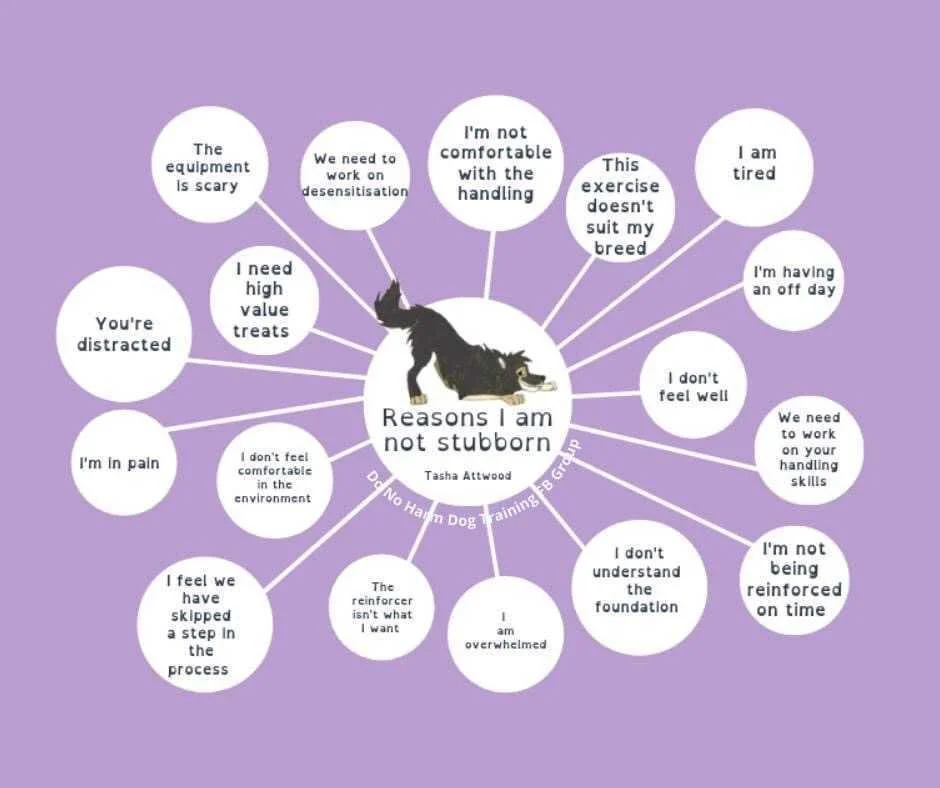
Is my dog stubborn, dominant or eager to please or does he even sometimes look guilty?
Those attributes have nothing to do with a dog!
1. Stubborn: Dogs just do what works for them.
2. Dominant: The root of all behaviour is
-> a) Getting enough to eat.
-> b) Avoiding being eaten.
-> c) Avoiding injury and disease.
-> d) Reproducing.
3. Guilty: It is far more likely that the dog is fearful. He is interpreting your actions and behaviour as unsafe.
4. Eager to Please: No properly functioning living thing does stuff for free. Dogs just have a different form of currency.
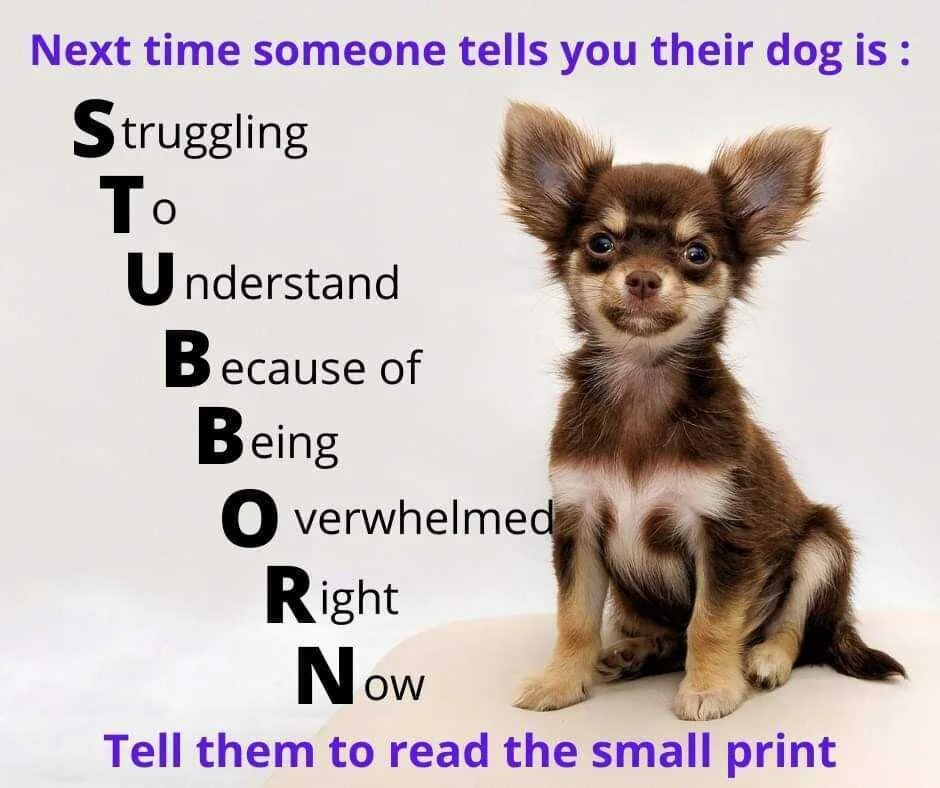 credit to Lynn Windell ↑
Why should I play with my dog?
1. Most dogs find a toy more rewarding than treats and are much more responsive out and about if the reward is a game of tug for instance.
2. Playing with our dogs is a bonding miracle. They love having fun with their favourite humans.
3. Scientists have recently determined that it takes approximately 400 repetitions to create a new synapse in the brain - unless it is done with PLAY, in which case, it takes between 10-20 repetitions. A magic training wand?
4. Play is great to practise impulse control.
5. Play is great mental and physical stimulation.
So, what are you waiting for!? Go grab a toy! :D
Why does my dog suddenly react sometimes?
Probably because they have had enough for the day! Click here to find out what trigger stacking is!
At what age can I start leaving my pup home alone for the day while we are at work?
It’s okay to be apart from our dogs and to leave them home alone and in fact important for them to learn this, but is there a limit to the amount of time our dogs should spend alone?
We believe the ideal maximum time adult dogs can be left alone without toiletting or social interactions is 4-6 hours if they have been slowly accustomed to this. We are however aware that some dogs have to cope with 8-9 hours due to work commitments. It would be nice to break up their days! Where we would definitely draw a line and ask you to get in help is when days alone start getting to 10-12 hours or more in a single stretch.
If your pup is left alone for more than a couple of hours, leave them in their puppy proofed long term confinement area. This is so they have an opportunity to toilet on a designated toilet area (pee pad or grass mat) if they need to go and can stretch their legs and play with their toys if they want to!
Your puppy should only ever be in a crate for 1 hour per every month of age (as that is the length of time they can generally hold their bladder comfortably). This means if your puppy is 2 months old, they should only be left in their crate for 2 hours maximum throughout the day - 3 months = 3 hours.
As mentioned above, we believe all dogs should be able to toilet and have social interaction throughout the day, even when they are adults whilst also spending time alone. The majority of dogs is better off being kept inside when left alone where they can relax rather than outside where there might be lots of stressful sounds that they have to cope with or feel they have to chase away. Speaking of stressful experiences: read here why we recommend to NOT send your dog to Daycare.
So what are some other alternatives?
Can you come home from work at lunch time? Can you work from at home on occasion? Can you bring your dog to work with you? Can you arrange for someone to visit?
If you require a professional service, consider a positive Pet Care Service that pops in to look after your dog and possibly also takes them out for a quick stroll. Or look into Group Walks: Well-run Group Walks help reduce social isolation and maximise your dog’s wellbeing. If you are interested in learning more about what to look out for in group walks click here.
Is it okay for my pup to chase it’s tail, snap at dust or obsess over leaves, flies and lights?
These behaviours are can be obsessive and unhealthy if executed frequently. They cause our dog's stress levels to rise, and don’t allow them to settle and rest properly, which can lead to other problem behaviours.
How do we prevent these behaviours?
Ensure all emotional and physical needs are met, and that they are getting sufficient mental enrichment and rest (18-20 hours per day). Make sure pup is not awake for more than 1.5 hours at a time.
If your pup is particularly reactive to something specific like lights, you may need to put management techniques in place for a while so that your pup is not exposed to the trigger while you work on gradually desensitising to it.
If they do begin to engage in an obsessive behaviour, it is important to interrupt them. We use our Reflex to Name exercise to do this. Use a very high value reward for your dog when doing this. Once you have their focus, redirect them and get them to focus on something else. Think about how you can alter your dogs routine to help encourage them to settle more.
These behaviours are particularly common in our herding/working type breeds like our Border Collies.
We do not recommend fetch as it is usually a quite stressful game for our dogs and can encourage obsessive behaviour. There are tons of better ways to mentally and physically stimulate our dogs.
If you have a Border Collie and you would like to learn more about your particular breed of dog and get more ideas of what drives them and how we can prevent lots of problem behaviours from occurring, watch this free Webinar from Epic Dog: click here
How much rest time do dogs need?
Firstly, let’s establish that all dogs are individuals. Like us, some may require more physical exertion than the average, or more mental stimulation, to be happy. That being said, like us, all dogs need adequate rest time to recharge. Adult dogs need anywhere between 12-18 hours of 𝑠𝑙𝑒𝑒𝑝 per day (large dogs and more sedentary dogs require the most sleep of all); puppies need ~18-20 hours of 𝑠𝑙𝑒𝑒𝑝.
When we talk about resting however, we are not only talking about sleep. We are also talking about good ol’ down time to stretch and chill out. Rest time doesn’t only involve time sleeping, it also involves curling up and enjoying something quiet and relaxing. From this perspective, 18 hours of rest a day for a dog isn’t a big ask. When we rest, we are giving our brains and our bodies time to recover from our activity-time, recuperating the much-needed resources required to keep us happy and healthy.
18 hours of rest for our dogs still leaves 6 hours for physical and mental engagement with their world, which will include sniffing around, going for walks, doing training activities, playing, and engaging in mentally stimulating activities. When we think about their ‘normal’ routines, 6 hours of activities and engagement is actually pretty huge! In fact, it will likely be more than they are used to.
Without a doubt, many dogs are struggling to get the rest time they need to be happy and relaxed at the moment. Their usual time alone for x-many hours a day is now gone. They are going for more walks than ever before and getting more engagement. Add to that, they are getting a lot more extra stimulation from people being home and seeing many more people and dogs on their walks, which requires even more rest for them to process. Yet under current conditions, they are getting less rest, reducing their ability to reestablish the mental and physical resources they need to cope. Over a short amount of time, this depletion of rest and increase in stress can add up to an extremely distressed dog, and even an injured family member. It is up to us as guardians to help our dogs and families adjust to these changes, keeping everyone safe and protecting our dogs from excessive stress.
To get a deeper understanding of what is going on for our dogs, let’s talk a little bit about a hormone called ‘cortisol’. Mammals produce cortisol, humans and dogs included. It is often referred to as a ‘stress hormone’ because its release can be triggered during stressful events (both in good ways, such as a play date, or fear-inducing ways, such as a threat or unknown object/animal). It is released during the cascade of mechanisms involved in our fight-or-flight response, and it interacts in complex ways with both our brains and our bodies, from our cortex to our bones. Looking at cortisol is one way we can decipher how our dogs are experiencing stress.
Just like us, different dogs will have different tolerances for different things. While Fifi might not be bothered by fireworks (shown by unchanged cortisol levels in her saliva), she might have a surge in cortisol when she sees an unknown dog walk past. Her furry companion Bruno might be the opposite, unbothered by the unknown dog but terrified by the fireworks! They might also react differently to their fear - while Bruno might start quietly whining and sniffing the grass, trying to ignore the threat, Fifi might decide her best course of action is to do an aggressive display to try to scare the threat away. They are both experiencing surges in cortisol, and if they are exposed to even more stress, those cortisol levels will continue to climb rather than drop. ‘Trigger stacking’ occurs when your dog is bombarded by stress after stress without having time to recuperate. This makes them more susceptible to being overwhelmed by things that they would usually accept. Their heightened cortisol levels also unsettle their ability to fully relax. It makes sense, then, that after ‘stressful’ things happen, our dogs really need quality down time.
When we think about stress for our dogs, we really do need to remember we are talking about both positive and negative experiences. Dogs have elevated cortisol levels after going for a walk, even when they enjoy it and have no negative experiences. While the dog with less walking experience is going to have the higher surge in cortisol, the dog who potters along quite happily is still experiencing an increase in their cortisol levels.
Similarly, your dog might absolutely love getting attention from everyone in the home. They might usually play with the kids quite happily and listen to your cues when you ask them to do things. They might love playing games of tug, or getting cuddles. Regardless of their usual enjoyment of these activities, there can indeed be too much of a good thing; endless engagement without quality rest won’t allow for their cortisol levels to naturally return to baseline, and, much like an overtired toddler, you might be in for a melt-down. The last thing you want for your dog is to get to the point where they are overflowing with stress; just as we can push ourselves too hard and ‘explode’, for everyone's’ sake we absolutely do not want to push our dogs to this point.
Luckily, we can use our understanding of stress to help our dogs relax and reinforce their mental health. Here are a 9 things to implement in your home to facilitate rest and reduce stress:
𝟏. 𝐌𝐀𝐊𝐄 𝐒𝐔𝐑𝐄 𝐓𝐇𝐄𝐘 𝐇𝐀𝐕𝐄 𝐓𝐇𝐄𝐈𝐑 𝐎𝐖𝐍 ‘𝐒𝐀𝐅𝐄-𝐒𝐏𝐀𝐂𝐄’: One of the most simple, yet most crucial things you can do for your dog is ensure they have their own space. This can be their crate, their bed, or wherever else they can be left undisturbed. The most important thing will be that they are never, ever disturbed in this place.
𝟐. 𝐊𝐄𝐄𝐏 𝐂𝐎𝐍𝐒𝐈𝐒𝐓𝐄𝐍𝐓 𝐁𝐄𝐃/𝐖𝐀𝐊𝐄 𝐓𝐈𝐌𝐄𝐒: Having good sleep hygiene isn’t just good for us, it’s good for our dogs too. Keep a routine for sleep/wake times, giving your dogs’ body the opportunity to get into a rhythm to maximize the benefits of their sleep. If you are staying up later than usual, make sure your dog is still going to bed around the same time as they normally would be. Utilize a crate, a pen area, or separate rooms if needed. If they have trouble settling, set them up with a dried meat chew, filled Kong or Lickimat to help them calm themselves.
𝟑. 𝐅𝐀𝐂𝐈𝐋𝐈𝐓𝐀𝐓𝐄 𝐀𝐋𝐎𝐍𝐄 𝐓𝐈𝐌𝐄: Make sure your dog gets their alone time every day regardless of whatever else is going on. This facilitates quality rest time, and also helps reduce/prevent separation issues.
𝟒. 𝐊𝐄𝐄𝐏 𝐘𝐎𝐔𝐑 𝐅𝐄𝐄𝐃𝐈𝐍𝐆 𝐑𝐎𝐔𝐓𝐈𝐍𝐄 𝐂𝐎𝐍𝐒𝐈𝐒𝐓𝐄𝐍𝐓: Even though it may be tempting to feed your dogs whenever works for you at the moment, unpredictability will be an extra unneeded stress for your dog. Keep your feeding times roughly around the same time every day.
𝟓. 𝐏𝐑𝐎𝐕𝐈𝐃𝐄 𝐓𝐎𝐘𝐒 𝐓𝐎 𝐋𝐈𝐂𝐊 𝐀𝐍𝐃 𝐂𝐇𝐄𝐖: Licking and chewing stimulates the release of calming chemicals in your dogs’ brain. Chewing a toy or licking a frozen kong can help facilitate recovery from stress-inducing events.
𝟔. 𝐑𝐄𝐅𝐑𝐀𝐈𝐍 𝐅𝐑𝐎𝐌 𝐎𝐕𝐄𝐑-𝐄𝐍𝐆𝐀𝐆𝐄𝐌𝐄𝐍𝐓: While it’s tempting, refrain from taking your dog out more than you usually would. If they are accustomed to walking for an hour a day, keep it at an hour a day. If you go out for an extra long walk, consider having a stay-at-home day the following day and focus more on quiet training. If they are accustomed to alone time during the day, be sure to give them that alone time instead of continuously bombarding them with play and affection.
𝟕. 𝐓𝐄𝐀𝐂𝐇 𝐊𝐈𝐃𝐒 𝐓𝐎 𝐏𝐀𝐓; 𝐏𝐄𝐓; 𝐏𝐀𝐔𝐒𝐄: One of the most important things you can teach children around dogs is to invite the dog over, rather than the child running to the dog. This gives the dog a chance to decline interaction, preventing an uncomfortable situation before it even occurs. Teach kids to pat their leg to invite them over; pet the dog only if they approach, from shoulder to the base of the tail; then pause to see if the dog wants more. A good opportunity to talk about consent!
𝟖. 𝐋𝐈𝐒𝐓𝐄𝐍 𝐓𝐎 𝐓𝐇𝐄𝐈𝐑 𝐒𝐈𝐆𝐍𝐀𝐋𝐒: Dogs are amazing communicators - they have a range of ways to tell others how they are feeling. Look at ‘the canine aggression ladder’ to review the cues dogs give when they are trying to increase space between themselves and whatever is stressing them out. These signals include ‘freezing’ (becoming stiff), giving the ‘side eye’ (showing the whites of eyes while looking at you from the side), nose licks (a quick tongue flick), lip flaring (raising their top lip to show their teeth), growling, all the way up to biting. Do not punish a growl - it is a clear, safe way for your dog to tell you that they have had enough. Respect their need for space.
𝟗. 𝐏𝐔𝐓 𝐌𝐀𝐍𝐀𝐆𝐄𝐌𝐄𝐍𝐓 𝐈𝐍 𝐏𝐋𝐀𝐂𝐄: If you are unable to monitor your dog around triggers at the moment, you will need to manage their environment. Some dogs might bark at the window when someone goes past - what may have been something that happened a couple of times a day, with the recent increase of people walking, it is likely that such dogs are getting bombarded with this stressor tenfold in a day. Limit their access to rooms or spaces where they are exposed to the trigger if you are unable to supervise them and preempt the behaviour with training. Furthermore, we cannot expect children to understand dog-language if we do not teach them, and it is very possible for a child to mistake ‘freezing’ with a ‘side eye’ as an invitation of play, when in fact it is the complete opposite. Use barriers, crates, rooms, and ‘safe spaces’ to ensure that your dog is not getting overwhelmed by potential triggers.
It is up to us to set them up for success by making sure their needs are met, which includes their much-needed quality rest time. Putting boundaries in place and accommodating for your dogs’ rest requirements is the best interest of everyone in your home, and will make for a much happier furry companion.
Puppy’s daily schedule
A young puppy’s schedule should mainly revolve around getting enough (18-20 hours) of proper REM sleep, interaction with their family and socialisation experiences.
Ensure that your pup is only up and about for maximum 1.5 hours at a time. This will help ensure your puppy doesn’t turn into a crazy, overtired, nippy pup! Some puppies can’t handle being awake for that long and need quiet time sooner, as quick as 20 minutes after waking up in some cases. Each pup is different.
Early morning:
- Gently wake puppy up, take them straight outside to toilet
- Bring pup inside and spend some time with them – be sure to feed their breakfast in some type of enrichment toy or toss their biscuits into the grass in the backyard so they can snuffle and search for each piece! Giving their breakfast in an enriching way does many things: It offers an outlet for that early morning energy and allows them to move around, keeps them busy while you make your own breakfast, and it also engages their brain and lets them play and problem solve which leads to a happy and satisfied pup!
- After their breakfast, they may want to go straight back to sleep, however some will stay up slightly longer.
- Short training session – only needs to be 2-5 minutes! You can use some of their breakfast for this if you’d like and be sure to add in a short play session.
- If you have a day of work ahead out of the house, the morning is a good time to give your pup a short socialisation session with the outside world. This could include a car ride, a short walk with your pup (can be in your arms or a pram), maybe a trip to a quiet park to have a cruise about and sniff on the long line is fantastic. For our younger pups, it could be simply sitting at the end of the drive, watching the morning’s activities!
- Your pup can then chill out with you if they haven't been up for too long yet and then back to bed!
Mid-morning: (if possible)
- Short training or play session, pup can hang out with you. Keep this nice and brief. Follow with a nap until pup needs their lunch.
Lunchtime:
- Wake up and have some lunch. If your puppy is under 4 months old, they should ideally be having 3 meals per day. If you can – pop their meal in an enrichment toy.
- If they are over 4 months, it is great to offer them something like a yummy meaty chew or licki mat.
- You can offer them another play or training session, or simply hang out with them.
- If midday is a better time (instead of the morning) to take them out for a socialisation experience – do this now.
- Back to bed!
Afternoon:
- Time for another socialisation experience! Each pup will be different in how long they can handle being out and about in the world for. Start small, 15 minutes is fine at first for a very young puppy, and as they get more confident and older, you can start to extend this.
- Play and/or short training session, hang out with you, then back to bed!
Evening:
- Dinner in an enrichment toy. Training session and a play, hang out with the family.
- Ensure that pup gets a good nap between the afternoon and evening – especially if the kids are coming home from school!
- Bedtime! Don’t forget to set your alarm for puppy overnight pee stops!
What is different about a Collie?
Collies, Collie crosses, and other working breeds are special. They are bred to be a sensitive, hard-working and intelligent dog who is quick to learn! They have also usually been bred for a specific job in a certain and unchanging environment, like farms. While this can make them amazing pets, it can prove troublesome to our Collies who are in pet homes. Collies are bred to be sensitive to movement and sounds and have a tendency to chase and herd things – no wonder many struggle with cars and bikes! They are also generally cautious dogs who require intensive, gentle, and sensitive socialisation experiences, particularly when they are puppies. Collies (and all dogs!) thrive on gentle and consistent guidance and training.
Collies can be prone to being intensely affected by a single bad experience, and struggle to “bounce back” when something goes wrong (single-event-learning).
We not only need to think of what they have been bred for but what they have not been bred for.
What are some things Collies can commonly struggle to deal with, and why?
- Socialising with lots of strange dogs and people – sheep farms can be busy places, but usually only with people and dogs they are used to working with and know well. During pet life, we often expect our dogs to interact with a range of strange people and dogs on a regular basis. Depending on the dog’s personality and their socialisation experiences, this can be stressful for them.
- Coping with noise – Collies are bred to have acutely accurate hearing, as they are required to be able to hear and understand a shepherd/farmer’s cues and signals from a great distance. Our urban lives can often be a bombardment of noise and visual stimuli for our Collies. Farms are usually relatively quiet places in contrast, apart from animal noises and occasional machinery noises, away from the hustle and bustle of city life.
- Coping with change – farms tend to be relatively unchanging places, most of the visitors, animals and machinery are usually pretty consistent. Every time our urban dogs walk down the street, it's likely something has changed. This could be new cars parked in different places, rubbish bins appearing and disappearing, different people and dogs, and even other animals.
What can I do to help my Collie cope with daily life?
- Provide mental enrichment alongside physical exercise to get those wonderful clever brains working!
- Hone into those natural instincts and give them an outlet for them! See below for some fun games to try!
- Provide a calm and undisturbed resting place, away from noise and activity.
- Provide consistent, sensitive socialisation experiences that involve fun and desired things (like fun games and yummy treats)
Why is fetch stressful and unsuitable for Collies?
Fetch is usually a quite stressful game for our dogs. There are tons of better ways to mentally and physically stimulate our dogs. We should always ask ourselves what were they actually bred to do and how can we satisfy that drive? The best example of ball-obsessed dogs is the Border Collie. They were bred to herd sheep. Can we replace this in real life without having sheep? Yes! :)
Read here why fetch is stressful and what are some things you can do to occupy and enrich your Collie’s brain and body!
Additionally to the points named, your Collie may also love to learn “Treibball” - here is a short video of the basic first steps to teaching this and more in depth courses are available on Fenzi Dog Sports Academy.
If you have a Border Collie and you would like to learn more about your particular breed of dog and get more ideas of what drives them and how we can prevent lots of problem behaviours from occurring, watch this free Webinar from Epic Dog, we can highly recommend it! At the end you will be offered to purchase a game called Sheep-Ball-Herding which is explained in such an awesome step-by-step manner that anyone can follow it and you will be blown away how 10 minutes of that brain training allowing the Collie to do exactly what they are bred to do, replace the most intense physical exercise regime!
Noise Desensitisation
Dogs who are scared//startled/triggered by noises can struggle to relax in a variety of situations. They can be hypervigilant, waiting for those triggering sounds so they can respond to them in ways that make them feel safer or give some sort of relief; quite often, this is barking to warn the sound away, or alternatively hiding in a perceived safe space. Both of these tactics are reinforcing - sounds can often be fleeting, leaving the dog satisfied that their behaviour indeed reduced the frequency or intensity of that sound. Thus, the cycle of fear or sensitisation of sounds and associated unwanted behaviours goes on. It is our responsibility to make our dogs feel safer and more relaxed.
It is also possible for a component of pain to be at play. Imagine you have a sore back; a sudden sound may cause you to move suddenly in ways that cause you more pain. You may then start to link feeling pain with sudden sounds, and the cycle of fear and pain continues, perhaps even after the initial cause of pain has healed. As with all training issues, we need to rule out underlying health issues by getting a full vet check. This particular issue is less common in puppies, so just something to be aware of.
We will use two techniques to help your dog overcome their sensitivity to sounds:
1) Desensitization: We play the sounds on the lowest possible volume for as many days as necessary. Only when we are sure our dogs aren’t bothered at all, we can turn it up by one nudge, still hardly noticeable for human hearing. We keep increasing at the pace the dog is happy with.
2) Counter Conditioning: Create a new involuntary response using classical conditioning. Find a recording of the sound or create it yourself. Teach your dog that whenever they hear the sound, a really yummy treat follows straight after.
Find sounds here
Can I leave my dog tied up outside? And how?
We only ever want to leave our dogs tied up somewhere we can see them, like quickly popping into a café with sight to the outside to grab a take-away coffee.
We discourage you leaving your dogs tied outside of places like the supermarket because there have been horror stories of dogs being mistreated or stolen when left there, and you have no visibility as to what’s happening. You can't control if a child runs up to your child and sticks their face right in your dog's face or accidentally steps on their tail. Pain can cause bites..
If you do choose to tie your dog up at some places in future, it is crucial that you teach them first gradually rather than just leaving them one day. Watch the video below to learn how to.
Remember, we don’t usually ask for a certain position when leaving our dog tied up somewhere as we just need for them to stay in the same area. As long as they stay in the general area, they can do a sit or down or move a little into the shade or whatever they are comfortable with.
So typically we don’t use a ‘stay’ for that, but an ‘I’ll be back’, which you can practice just outside your house to begin with and then gradually at slightly harder places. Our goal is not to get to long durations. A good rule of thumb is the goal of leaving the dog tied at a table at a café while you go up to the counter and order your drink while you always can still see your dog and step in if needed.
Check out our video here that goes through the process of teaching the ‘I’ll be back’ step by step.
I have children. Is there anything I should be aware of?
Introducing cats and puppies
For most cats, a puppy coming into the household is a big deal. Some cats may struggle to adjust. If your cat is particularly anxious, a great tool that can really help is using a Feliway diffuser. Feliway is synthetic pheromone that helps cats feel safe and relax. It is available from most vets and pet stores.
Firstly, we want every interaction between the cat and pup to be positive, calm and not scary for either of them. It really does go back to management and training.
At the beginning of a training journey we need 100% management and have done 0% training. Then, the more training we do the less management we need. Anytime our pup gets to rehearse/practise the unwanted behaviour we are undoing a big chunk of our training and require more management again.
Our pup should never get the chance to chase the cat (we appreciate that pup usually wants to play, but the cat doesn't and also it could go quite wrong – we need to remember that most dogs are bigger and stronger than cats even when they are young) and that is through management.
Utilise things like baby gates and puppy pens to give the cat space to move away from pup without pup being able to follow. Chasing is self-reinforcing for any dogs (it's fun!), hence why we never allow them to do it.
When you have time to do training, have your pup on the lead and bring the cat inside and reward the pup for being calm. We need to have enough distance between the pup and cat that both of them are calm. This might be across an entire room, and your cat may feel safer up higher (on a table or couch) rather than on the floor. It is important to go at your pets’ pace.
If one of them gets too excited or stressed, we need to increase the distance. Gradually you can increase the difficulty (decreasing the distance between cat and pup) until your pup learns not to chase the cat anymore.
Let's have a look what science says about this:
What the humans do when they first bring their puppy home makes a difference in how the puppy learns to act around the cat, as this new study shows. Researchers asked people who had recently welcomed a new puppy into a home with a cat about what they did, what they expected to happen, and how their puppy behaved.
“Multivariable logistic regression showed early (puppies aged under 12 weeks), gradual introductions and living in a multi-dog household increased the odds of ‘only desirable’ behaviours. Qualitative analysis revealed two styles of introductions — owner-led and pet-led. Owners who led introductions anticipated amicable relationships between pets, whilst owners who let pets introduce themselves did not. Early, gradual, owner-led introductions of puppies to household cats should be encouraged.”
Full Study text
Introducing dog and kitten
Should I let my cat swipe/hiss at my puppy?
If your cat feels the need to swipe at your pup, it means that the cat is feeling unsafe, scared and the need to defend themselves.
Your cat should never be put in a situation where they feel that way in their own home as that will only serve to start your pup's and cat's relationship off in a bad way and continue to break it down further the more it continues.
Additionally it will increae the arousal the puppy feels around the cat and make it even harder next time for the puppy to be calm.
A peaceful and harmonious relationship needs to come from a place of calm, trust and respect for each other’s space.
Instead, your puppy needs to be taught how to be around the cat in a calm and respectful way, in a way and at a distance the cat still feels safe.
While they are learning to be around each other, they should never be left alone together. This can eventually be a goal you work towards.
What is "Littermate Syndrome"? What do I need to know?
We recommend not to adopt two puppies (same litter or not) at the same time.
"Anecdotal evidence suggests that behavioral issues may arise during key development periods because the two puppies’ deep bond impedes their individual ability to absorb and grasp the nuances of human and canine communication. Since fear is the canine’s default reaction to odd or unfamiliar stimuli, this muddled understanding of the world around them can lead to impaired coping mechanisms later on."
Read more here on the potential issues but also how to prevent them.
How to introduce my new puppy to my other dog/s.
What are the rules between my existing dog and my new puppy?
Firstly, it is a good idea to introduce your new puppy and your existing dog(s) to each other on neutral territory. Somewhere that is safe and enclosed/fenced with lots of space that neither dog considers as their home.
One of the most important things to remember when introducing a new puppy to existing dogs in the household is to give the older dog(s) time away from the puppy. Please do not expect your other dogs to “teach the puppy how to behave”, it is our job as puppy/dog parents to make sure everyone in the house is happy and healthy.
If dogs are left to their own devices with one another, it can lead to conflict between them. It is up to us to step in and play referee and remove the dogs from each other if play gets too intense or one dog is not enjoying the interaction anymore. Puppies are notorious for pestering other dogs, they will likely not appreciate this.
Make sure anytime the dogs are together while still getting to know one another (and pup is still young) their interaction is supervised by an adult.
If the dogs in the household are prone to playing with each other too much we can implement some training to help the dogs learn to settle around each other. Being able to chill out and relax with each other is just as, if not more, important than the dogs playing happily with each other. Learning to spot the signs that a dog may display if they are feeling overwhelmed or uncomfortable with what is going on is a really important and helpful tool. These can be things like lip licking, turning or moving away, a warning growl (different to a play growl), yawning and many others.
The dogs are allowed to play with each other if you are fine with this. However, you do want to make sure that at any point both dogs are having a good time. If they don't you need to step in. It is not on them to sort it out. It's on mum and dad to put boundaries in place.
If play gets too rough or you have had enough, you can teach your dogs the cue "Enough" (said with a friendly voice).
We teach this by saying it and walking in between with treats and asking the dogs to sit and then lay down. We let them calm down and reward them. When we release them, we reward them for going their own ways.
If they go straight back to play, we repeat our steps. Maybe they need longer to calm down, or a bigger distance between them?
Over time you will get to a point where you just need to say "Enough" and they stop playing.
Why should I make my dog work for their food?
For the vast majority of animals, finding food takes up a huge amount of their time and energy.
Our domesticated pets often have this behavioural opportunity removed, resulting in a huge behaviour deficit.
We then wonder why they develop behaviour problems.
Many factors may contribute to behaviour problems but a major player is simply a lack of appropriate stimulation.
Quality of life matters!
Enrichment feeding is about adding greater value and benefit to their food, allowing them to use their brain and engage in natural behaviours.
It gives opportunities for the dog to be successful, builds confidence and develops optimism. It's about love for the dog and meeting their needs.
How do I teach my dog a 'Find It'?
Watch here how to teach your pup how to find their food and later on a toy as well.
What are games I can play out and about?
A cool wee exercise you could do when out on walks is using the items you come across like an obstacle course.
Appropriate ways for dogs to fulfill their intrinsic needs - Turning the illegal into legal!
These are all normal dog behaviours! For the vast majority of animals, finding food takes up a huge amount of their time and energy. Our domesticated dogs often have this behavioural opportunity removed, resulting in a huge behaviour deficit. We then wonder why they develop behaviour problems.
Many factors may contribute to behaviour problems, but a major player is simply a lack of appropriate stimulation. Here are a few easy examples of how to give your dog more access to legal ways of fulfilling their intrinsic needs:
1. SNIFFING/MOOCHING: While humans are mostly visual creatures, dogs are all about smells. They have millions more olfactory sensors than humans do, and they even have an extra organ, the vomeronasal organ, on the roof of their mouth for the purpose of processing smells. Asking a dog to not sniff during a walk is pretty much the same as asking a person to walk around wearing a blindfold!
If you really want to tire out your dog, you need to enrich both their body and mind at the same time. Sniffing a particular scent and then interpreting the accompanying information is the canine version of a mental work out - think doggy soduku puzzle!
A walk where they’re allowed to sniff until they’re mentally content is the perfect opportunity to address both your dog’s physical and mental needs. Dogs are dependent on their owners, and along with regular meals and a place to call home, that arrangement comes with a good deal of confinement. Your four-legged family member has almost no control over their life, and that feeling of constantly being constrained can play its toll on their mental health.
A daily walk is your chance to give your dog some slack and let them make decisions on their own. If they want to spend five whole minutes sniffing every inch of a fire hydrant, let them. It’s a small decision in the grand scheme of things, but the chance to choose will do a great deal of good for their mental health. If you spend every step of every walk forcing your dog to heel by your side and making every decision on which way you turn, you could be adding to their stress when you want to be relieving it.
2. TRACKING: The perfect outlet for dogs to use their nose and brains doing what they do best. 10 minutes of tracking replaces a 50-minute run through the park. A great way to give them the combination of mental and physical stimulation when you either don’t have the time for a walk or your dog needs to stay home for a bit to calm their nerves. Plus it is amazing for your bond with your dog and a cool game to play together!
Start with teaching our dogs a find-it with treats and gradually work up to a toy. Be aware to always have your dogs succeed and only gradually make it harder. You will be amazed how far distances your dog will track soon!
3. DIGGING: If it’s stress related your dog is likely better off being kept inside. If your dog just enjoys digging, build him a sandbox!
What toys you would find on your dog's wish-list?
Our dogs need mental stimulation. Giving food for free is a wasted opportunity. So, besides using the food for training, we can use it to occupy our dogs and make them calm and mentally tired by using food toys.
Click Here for a few examples.
Most of these toys can be found in our specialist store if you are interested in learning more about them or purchasing one.
What ingredients can I fill my Kong or Lickimat with?
Try any new ingredients in your presence in small quantities prior to stuffing into your pup's enrichment toys. This way you ensure your pup does not have A.) An allergic reaction to any new ingredients or B.) Tummy upsets. Every dog is different and not everything will agree with every dog. Also, let’s remember that moderation is key! And if you’re ever unsure, please consult your vet.
Sweetener free – this ingredient comes up as “xylitol” on product labels. Please be aware that artificial sweeteners (xylitol) are toxic to dogs.
Wet Ingredients or “Binders”: Excellent for using to “bind” inner stuffing ingredients together, or spread on lickimats!
- Peanut butter (xylitol free)
- Applesauce (sugar and sweetener free – I make mine in the instant pot!)
- Low fat Cottage Cheese
- Plain Greek Yogurt
- Cooked Steel Cut Oats (not the instant packets – they contain lots of added sugar)
- Plain Cream Cheese
- Mashed Banana
- Soaked Kibble (in water or broth)
- Cooked white rice soaked in broth
- Pure Pumpkin puree (not to be confused with pie filling)
- Organic baby food (with dog safe ingredients – always read the label. Ensure there is no onion/ grape/chocolate/ sweetener).
- Mashed Sweet Potato (cooked)
- Purees (i.e. carrot puree, green bean puree, you name it)
- Coconut Oil (be mindful not to fill your whole Kong/ lickimat, or you’ll have a dog ready for a poop break!)
- Bone Broth
- Liver paste
- Egg (raw, hard boiled/diced)
We got a new toy (Kong, puzzle toy, etc) and my pup won’t play with it.
We want to make each new toy fun, easy and super rewarding for our pups! If we get a Kong and immediately fill it and freeze it, our pups can get disinterested because it is too hard for them to figure out and so becomes frustrating and unrewarding for them. We want to make the toy super easy and fun to play with the first time they interact with it.
A Kong for example, should first be filled with loose biscuits or something that easily falls out when the kong is moved so that your pup is immediately rewarded for each little attempt. You can even demonstrate to your pup at first and play with them and the toy the first few times. Encourage them to roll it and point out the treats when they fall out! If using a puzzle toy, put it on the easiest setting possible. Make sure the first few times they use it the treats are easily obtainable and high value (super yummy) for your pup, particularly if your puppy isn’t usually motivated by their normal kibble.
Gradually as they start to have fun with the toy and understand how to use it to extract the rewards, you can make it slightly harder.
A Kong or another toy you fill with food could be increased in difficulty as follows:
- Loose hard treats
- Slightly squishier treats that require slightly more effort to dislodge (cooked chicken, egg, etc)
- Loose treats and peanut butter or a favourite wet food smeared around the entrance of the toy
- Bottom of kong filled with wet food, topped with loose kibble
- Wet food smeared/squished into it
- Wet food squished into the Kong, then put in the fridge (slightly harder than room temp food)
- Frozen wet food, with some easily obtained yummies at the very top after taken out of the freezer
- Fully frozen Kong
Should I play tug with my puppy? Can I let them win the game?
Yes, Absolutely, have fun with your puppy! Just remember to be gentle with their teeth and play low to the floor so they are not having to jump for the tug toy. Use gentle sweeping side to side movements.
We recommend a long soft tug as a first tug toy, something like plaited fleece or towel, like this for example. Hard rope toys can be rough on their puppy teeth and gums, particularly when they are teething. The length of the toy keeps those sharp puppy teeth away from your hands!
If your puppy starts making noises (playful growling, etc) when you play tug it is a natural normal thing for them to do, some puppies are more vocal than others – this just means they are enjoying it!
LET THEM WIN!! Let them take the toy away from you every now and then – who would want to play a game they never win?
Things to remember:
- Keep play sessions short. 2-5 minutes is enough for a young puppy, more can overstimulate them.
- If they get too intense, end the play session, and keep it slightly shorter and/or calmer next time you play.
- If they make contact with your skin, calmly and quietly end the game. Sometimes they connect with our hands without meaning to in the excitement of the game, this is where our long tug toys are helpful!
- If you are worried about how your puppy is acting during tug and are not sure about their behaviour, you are welcome to take a short video of you playing together and send it into us for us to watch, we can let you know if the play you are seeing from your pup is okay.
- If your puppy struggles to settle after a tug game has ended you can use an end cue – something to signal the end of the game. You can say something like “all finished!” and toss a few treats on the floor for them to snuffle up before you put the toy away out of sight. Putting the toy away prevents them from being able to demand further play with it, and sniffing around for the treats helps calm them down and lower their heart rate.
- Keeping a particular toy for just tug play with you (it goes away after sessions and isn’t left on the floor) keeps it exciting and high value and prevents the toy from becoming boring to your puppy or getting destroyed.
I'd like my pup to learn swimming.
We want to introduce our puppies to the water nice and gradually. We want to take them somewhere that has a nice gradual slope into deeper water, to prevent them from suddenly falling into deeper water, as this will be scary for them.
Pups can often be a bit worried about waves, so it is nice to start with water in a calm area with no waves so they can get their paws wet. Somewhere like a lake or estuary. Once they are calm and happily paddling in the water and you want to start teaching them to swim, you can go into the water together and when they can’t touch, carry them one foot further and then ‘swim’ back together to get them used to it.
While they are still learning, make sure you are close to your pup so if they do get worried or in trouble, you are right there to help them out.
How do I change behaviour without punishment?
Having a dog can be really challenging and when our dogs are exhibiting behaviour we find difficult to cope with it can be easy to feel resentful and look for quick fixes. That said, it’s important to remember a couple of things:
- Your dog is essentially the same as a two year old child for life in terms of emotional awareness/ cognitive capacity.
- Your dog isn’t purposefully giving you a hard time - he’s struggling to regulate his own emotions and therefore behaviour (just like a child might)
Dog guardians often struggle with understanding how positive reinforcement can change problem behaviour. This handout summarizes all the ways we can change behaviour without punishment.
How to interrupt unwanted behaviours
Whenever our puppy performs an unwanted behaviour, we can utilise our Reflex to Name exercise that we learnt during the puppy seminar to interrupt them and distract them from whatever they might be doing.
1. Consistently keep up the Reflex to Name exercise (announce name, immediately pop a treat in their mouth within a couple of seconds) 40-50 times per day. If it is helpful to you, break up this amount of treats in the morning and keep them in a container on the kitchen bench or somewhere similar out of puppy's reach, and every time you walk past it, grab a treat (or a few, but not more than 5!) and practice your Reflex to Name!
2. When your pup is doing something unwanted - for example: chewing a chair leg, scratching the carpet, humping, etc. we grab a treat - just like we have done 40-50 other times that day - and do our Reflex to Name exercise in exactly the same way. Do this a few times in a row to lure your puppy away from whatever he was doing, then redirect his attention to something better (playing with a toy, etc.).
The reason we can use this method is because we have praticed the exercise many times that day while they are not doing any unwanted behaviours, the once or twice you may have to use this exercise for distraction when they are doing something we don't want them to do your pup will not make the association that chewing/scratching/humping = reward and still you haven't taught them that those behaviours will get your attention.
The Unattended Cake Effect
WHAT WERE YOU LIKE AS A KID?
What is the unattended cake effect?
When you were about 3, did you have a good amount of impulse control?
If a grown up put a chocolate cake on the floor and left you with it for about 10 minutes...would you sneakily dip your finger in or give it a cheeky taste?
What if they told you not to eat it but left it alone for a whole hour, in the middle of the floor, with all its fabulous smells?
I’m guessing that most three year olds would probably fail this test!
Most untrained dogs would too, and some trained ones would be very poorly and result in a vet visit.
Why?
Because a dogs cognitive ability is comparable in most cases to a 2-3 year old tot.
DOG MYTHS!
When I initially meet clients, often I hear the words “he’s doing it to be dominant”, “he’s doing it to put her in her place” and “she rules the roost”.
Dominance and pack theory has actually been debunked by one of the people that came up with the hypothesis in the first place.
There’s a famous saying in dog training by Jean Donaldson : “Dogs do what works!”
And she is totally right!
If you go back to the kids and unattended cake effect - are the kids in question trying to run for US presidency? Prime minister? Steal your house deeds?
Nope - they like tasty cake, and one is right in front of them! They “do what works”.
Dogs steal food as it’s tasty.
Dogs steal toys as it’s fun.
They push through doorways through excitement and haven’t been taught otherwise.
They jump on furniture and beds as they are comfy, or to safety to get away from scary or annoying things.
They growl at other dogs if they are scared, are trying to initiate interaction but don’t know how to appropriately. They may be protecting something of value to them, not because they want to overthrow humanity but they are protecting it, like we don’t like people mugging handbags!
This is why safe management strategies are so important and help teach self control and stop them from practicing inappropriate behaviour - e.g. think of the kid and unattended cake effect.
Would the outcome be different if the cake was in a locked cupboard?
What about if there was sliced fruit out instead?
Congratulations- you as a toddler have been set up to make a choice that is desirable and works for you!
Us grown ups are just as bad! Is healthy eating harder or easier when you go out for a meal, or at home?
Would you still have dessert if no ice cream was in the house?
How do you see the Kids and Unattended Cake Effect in your own dogs training?
This information is courtesy of Ruby + Betsy Joyful Dog Training.
What should I do if my puppy growls?
Don't punish the growl!
Punishment can suppress aggressive and fearful behavior when used effectively, but it may not change the underlying cause of the behaviour. For instance, if the dog behaves aggressively due to fear, then the use of force to stop the fearful reactions will make the dog more fearful while at the same time suppressing or masking the outward signs of fear; (e.g., a threat display/growling). As a result, if the dog faces a situation where it is extremely fearful, it may suddenly act with heightened aggression and with fewer warning signs. In other words, it may now attack more aggressively or with no warning, making it much more dangerous.
Instead, figure out why your dog growls and work on changing its emotional response to the scary trigger.
What is resource guarding?
Resource guarding occurs when a dog has, or is around, something they find very valuable. This could be a special treat, their bed, their food bowl, some rubbish they’ve found, a human or toys. Resource guarding is normal dog behavior. Dogs have evolved as opportunistic feeders, and it is natural for them to protect what they consider to be their valuable treasure from potential threats. They will begin signalling discomfort through escalating aggression (see ‘canine-aggression ladder’). Aggression signals in canines can be an important form of communication to avoid conflict.
Resource guarding can be identified by other subtle changes in behaviour, such as eating faster or putting their body in between the perceived threat and their resource. If they feel the need to tell someone or something to “back off”, they will utilize their social toolbox and use their subtle signals such as lip licking, growling, freezing still and giving the side eye. If this works well enough for their desired effect, they will not escalate their signals further. If their signals are ignored or challenged, they may escalate into growling, all the way up to biting in the worst instances.
Whilst resource guarding is normal, it is still important to work on it as it is important for humans to be able to remove dangerous items from their dogs and for children to be safe around dogs and their resources.
It's important to remember that the things our dogs find valuable can be changeable; what they are resource guarding today might be different from what they feel they need to guard next month. Because of this, the best way we can help our dogs minimize resource guarding tendencies is to focus on the bigger picture, rather than just the item in question on a given day. To do this, rather than look at training around a certain toy, we are instead going to focus on altering our dogs’ emotional state - we want them to look forward to seeing us (or other animals) while they have possession of, or access to, whatever they find valuable.
What NOT to do in order to minimize resource guarding behaviours!
Very common advice you will find on the internet is to pet your dog or play with the food in their bowl while they are eating, or to remove the food from them and then give it back. If you try these techniques, you will in the best case scenario just be an annoyance to your dog while they are trying to enjoy a meal. In the worst case scenario you are creating serious defiance towards you near their food and therefore the guarding behaviour is created and continuously escalated.
Minimizing resource guarding
We always want to teach our dogs that our presence means good things are going to happen. We don’t want to make them fear losing what they have; to no surprise, taking food off your dog does not teach them how to enjoy the presence of others around valuable things. However, providing them with positive experiences while they have access to high value items can change their minds.
It would be counterproductive attempting to stop our dogs from using their subtle warning signals; all we would be doing is making them bottle up displays of their emotions at times where their behaviour would be mild. By ignoring those signals and pushing forward anyway, we can unintentionally invoke aggressive behaviour much higher up on the aggression ladder, such as lunging and nipping. We actually want our dogs to be able to use these relatively safe signals to show their discomfort, giving us the opportunity to moderate our behaviour, modify the environment accordingly and address the identified issues through training.
As with most training, our first tool to use is MANAGEMENT. We want to prevent as many potential negative feelings around prized resources as possible. This means giving your dog ample space when they have prized things.
If they are the sole dog in the home, you will only need to monitor the humans in the home. This means making sure everyone knows, and follows, the rules. If you cannot guarantee that, it is best you utilize a quiet area or crate.
If you are in a multi-dog household, you can set your dogs up for success by providing your dogs with separate areas to enjoy their goodies, whether that be in a different room from one another, in their crates, or seperated with an appropriate divider (e.g. puppy-fence/baby gate). Unless you are actively supervising your dogs, it is best not to leave them together with high valued treats or toys, particularly if they have any history or tendencies to guard resources.
Start building up positive associations by using the TREAT & RETREAT method:
Go review the ‘canine aggression ladder’ infographic in our whānau resources or here: https://www.sithappens.co.nz/aggression-ladder
1. Give your dog a high value goodie, or be ready for when they have chosen one for themselves and are enjoying it.
2. Watch your dogs’ body language as you approach the area. There is no need to rush your dog.
3. Stop before your dog shows discomfort or back up if you have overstepped, in range of throwing a treat, and gently toss the treat towards your dog.
4. Walk away.
Sounds simple? That’s because it is, and it works. What we are doing here is showing our dog they have nothing to lose from our presence (they lost nothing) and everything to gain (a freebie treat). Like all our training, you need to go at your dogs’ pace in order for it to be successful. Don’t jump the gun or try to rush them through it.
When doing your treat & retreat at your dogs pace, you will begin to notice your dog perking up when you approach. This is what we are looking for - the expectation of something good coming. Continue to reward them using your treat & retreat, reducing the distance between you and your dog in slow increments once they have shown happy signals at the last distance you used. Eventually, if you have taken the time your dog needed, you should be able to bring your hand to the dog’s resource and add your high value treat right on top of it; moving forward from there, at some point your dog will even look forward to you picking up the item because they know it will come back with even more goodness on top. Do not rush it and only move forward if your dog’s head backs away from the item and they look at you full of positive expectancy.
If you have more than one dog and are concerned about potential resource guarding issues between them, you will also use the treat & retreat method described above but with a barrier between your dogs. If you do not have access to a barrier, you can use their leads to maintain a comfortable distance for each of them. Allow them to move away from one another but not towards each other - you need to be the one keeping an eye on each dogs’ signalling and preventing them from even getting to that point while providing the treats to create a positive association. Follow the same principle as the treat & retreat for humans.
You should also practice swapping one goodie for another with your dog/s. This is especially helpful when they get hold of things they're not supposed to have. Set them up for success by asking them to ‘swap’ their low-value toy/item for your high-value toy or chewie. Rather than approach your dog to swap, call them over to you to reduce the pressure. Our reward needs to be better than what they have. Very gradually you can ask your dog to swap things that are a bit higher in value - always going at your dogs pace.
In essence, the aim is to improve your dogs’ emotional state around the things they value the most, such as a special toy or certain foods. We are increasing their optimism that good things, rather than bad things, happen when you’re around their goodies. In the long run, your dog will be much happier, and healthier, for it.
Why we don’t yell at our dogs when they protect items aka resource guard...
Imagine you were in a room filled with close friends and family that you trust, and you had two possessions on you- your phone and your keys. Knowing everyone in the room, you’ll probably pop the possessions down on a table and leave them there while you mingle, probably only going back to them when you are ready to leave. If somebody touched them, you probably wouldn’t care too much as you wouldn’t assume malicious intent, they probably just grabbed the wrong set of keys.
Now imagine you’re in a room filled with complete strangers. Same scenario, but these are people you don’t trust. Would you leave your possessions? No, you’d probably keep them in your hands or at least under close supervision. If you did pop them down somewhere and a stranger picked them up, I’m sure you would feel very uneasy and would want them back immediately.
Okay, so now imagine you have an open box of your favourite chocolates in the world. You’re in the room with your family and friends, who also love those chocolates, but you don’t want to share. Are you going to be as care-free with the box of chocolates as you were with your phone and keys, leaving them out of sight? I know I wouldn’t trust my friends and family that much, based on past chocolate-stealing experiences! So you are more likely to want to keep the chocolates either with you, or under closer supervision.
A lot of the time, dogs resource guard because they don’t feel comfortable or have had experiences of things being taken from them. Punishing a dog that is guarding something isn’t going to help them become more confident, it won’t build their trust. Taking things away from them will reinforce that fear. The more my family steal my chocolate, the more inclined I am to eat it all in one go or hide it away somewhere safe, and also the more likely I am to get frustrated when they try to get at it.
So what can we do? Cut off my access to chocolate altogether?
Maybe, but one day I will come across some chocolate that somebody has forgotten about and because it’s been so heavily limited, that chocolate may have become a hugely valued resource- even more so than before. That means I’m even more likely to want to keep it all to myself.
But wait, why am I guarding chocolate but not my keys or phone? Because I have never had my keys or phone stolen by family or friends. People respect that they’re mine and they don’t try to take them. So maybe, instead of punishment or limiting access, we should instead try our best to make a dog feel comfortable about their resources, teach them that they’re secure and not going to be stolen.
Credit to 'Make Your Mark Dog Training and Behaviour' - original Facebook post here
Why we don't use the word 'no'
Whilst it is tempting to just shout ‘No’ in order to stop the behaviour, this is very much a quick fix and likely to make the issue worse because it won’t get to the root cause of the behaviour (i.e. the ‘why’). We never recommend telling your dog off or using ‘no’, since dogs simply don’t know what ‘no’ means (our human concept of ‘right’ and ‘wrong’ behaviour is a social construct) and all of these methods can actually make behaviour worse by increasing overarousal and damaging your relationship with your dog (making you become unpredictable and scary to them).
'No' is a very over used word with dogs. It has absolutely no meaning to them. If your dog knew what 'no' meant, you wouldn't need to repeat it constantly, use it in combination with some sort of other punishment, do something else to stop the behaviour such as pull them off someone they are jumping on or remove the sock from their mouth and especially you wouldn't need to use a more and more angry voice every time. Saying 'no' does not tell the dog what to do, it just tells them that you are angry.
When a human is angry, for any dog – especially just a wee pup, it can be very intimidating for them. In response to being told 'no', some puppies/dogs can respond by barking/lunging, thinking they need to defend themselves.
Most importantly using 'no' does not teach the dog what you would like them to do instead. It can lead to our dogs shutting down.
Shutting down means the dog does not understand what their guardian wants from them, so they just do nothing. This is commonly seen at vets, when dogs aren’t moving or interacting with anything around them. People will commonly think that the dog is great with the vet, letting the vet do everything with them, but in reality, the dog is in a shut down state of mind where they think they can’t do anything or move which is very stressful!
Over-using this word 'no' also shows that your management techniques are failing too much. Your management should prevent your dog from doing what you don’t want them to do (jumping on people, stealing things, chewing things they shouldn’t), so they create better habits.
We have an emergency exit strategy for situations where the dog is rehearsing unwanted behaviours. Because despite having good management in place, no one is perfect. In these scenarios we utilise our “Reflex to Name” exercise and then redirect their attention to something else. Just remember to practise the exercise plenty throughout the day when your pup is doing good things, so it's not linked to certain unwanted behaviours only.
For more info on why telling a dog they are wrong is not necessary check out this article.
Counter Surfing/Jumping up on the bench or table
This is a common problem when our pups are finally tall enough to reach the top of the kitchen counter.
The most important thing is to never ever leave something tasty where they can reach.
1. Keep all food away in locked cupboards and everything else pushed back as far away from the edge of the counter as possible and needed. We need to do this because our dogs are opportunitsts: if they succeed just once, and are rewarded with something delicious and reinforcing, they will continue to try again, to see if there is going to be something else delicious up there!
2. Prevent access to the bench/table while you are not there. Do this by utilising management techniques such as baby gates, closing doors and using a secure long-term confinement area for your pup.
3. Teach a default Leave It this way.
4. If pup jumps up, say 'Off' (don't say 'Down' as that is a different cue) before moving towards them as we want them to respond to the cue rather than your movement. If they respond by jumping down, say 'Good boy/girl/pup' and go about your day for another half a minute to avoid giving your pup attention for the unwanted behaviour. If they didn't jump back up again in that time, you can now take them away and give them something else to do.
If pup does not respond to the 'off' cue, calmly walk towards them and gently take them by the collar/harness to lead them down and away from the counter. Go about your day for half a minute. If they didn't jump back up again in that time, you can now take them away and give them something else to do.
5. Make sure you never reward with a treat once they get down, as we do not want them to chain a behaviour and think “I get on counter - mum/dad tells me to get off - I get off - then I get a treat”.
6. If our pup immediately comes back and jumps up on the counter again, repeat the 'off' sequence, but this time don't wait 30 seconds and gently lead them to their crate or longterm confinement area, and leave them in there for 5-30 seconds. Repeat if necessary when they come out from their crate.
7. If your pup already knows their 'Leave It' cue really well, we can use this instead of the 'off'.
As above, we do not want to reward this with a treat. Just make a note of how many times you had to use the 'Leave It' on that day, and do a training session of the 'Leave It' cue exercise with treats later on that day. We want to do this twice the amount of times we had to use the 'Leave It' without a treat, so, if you had to use it 3 times, do at least 6 repetitions of the exercise in your training session. This is so they continue to get rewarded for responding to our cue, but we will not run the risk of our pups chaining the behaviour.
My puppy attacks the vacuum/broom
There are different reasons why our pups do this. Generally those items are highly triggering, either in the sense of prey drive or in the sense of being threatening.
In order to work on this, we want to start on a distance that our puppy is not reacting to the trigger. This might be 10 meters or more to begin with. That’s okay. Once they become comfortable with it, we can gradually reduce the distance between our pup and the object. We need to be far enough away from the object that our puppy is relaxed and happily taking treats.
We want to start with the object stationary and silent, and reward our puppy for being calm. We gradually start to move the object. We build this up in small increments and can gradually decrease the distance between our pup and the object.
Watch our video here on how to get your puppy used to the sound and movement of the vacuum cleaner. The same principle can be used with a broom.
Barking
Barking is a very complex topic, as our dogs bark for all sorts of different reasons. This can be for attention, frustration, over-arousal, boredom, pain, fear, anxiety or stem from the fight response.
Most commonly for puppies, barking at an owner is usually attention seeking behaviour, however, we must make sure all their emotional and physical needs are met.
Your pup is not naughty for barking at you – he is simply trying to figure out what works, and what doesn’t. It is up to us to ensure we respond to it in a way that will encourage our pup to perform a better alternative behaviour in future.
Ensure that your pup is getting enough rest during the day. If they do not get an adequate amount of sleep and quiet time (18-20 hours per day), this can lead to them being more reactive.
If our puppy is indeed barking at us for attention it is essential that we make things on our terms. This means that if our pup comes up and demands attention, either by barking, pawing at us, whining, etc, then we need to ignore this behaviour until our puppy decides it will go do something else, like lay quietly beside us. Then, once puppy has stopped demanding our attention, we can invite puppy over for a cuddle or a play.
For further reading on this topic, please refer to our Sit Happens Whānau group posts on Canine Vocalisation here under Unit 4: Caring for Your Dog's Mental Health. If you are not in this client-exclusive group yet, please ask to join and give your details, so we can identify you.
Alternatively read here.
My pup barks while they are in the car, what can I do?
If this is happening, it is extremely important that while you are working through this your pup is not left in the car alone and given the chance to rehearse the behaviour, to prevent forming an unwanted/stressful habit. We also need to figure out WHY our pup might be barking.
Possible reasons: (Some pups can be affected by one or several of these things)
· Fear of the car/car moving
· Fear of things or people outside of the car
· Car sickness – if your pup is drooling, vomiting, etc. in the car this is a sign that they are feeling ill. Please read our FAQ on Car sickness.
· Over-excitement
· Separation distress when you exit the car and leave them behind
Fear:
Unease or even fear around the car when puppies are young is common, but it is important for us as guardians to set our dogs up for success and help them feel comfortable in the car. The car is usually going to be an unavoidable part of life for our pups so starting early and giving them good experiences is important.
When seeing fear or stress in a puppy in a car you may see things like, panting, shaking, pacing, whining or barking and reluctance to go in or even near the car. If you think your pup is worried about the car itself please read and follow our guidelines for getting your pup comfortable in the car here - if you are unsure, we suggest checking this off the list before diving into other possibilities!
If the fear is based around things/people/animals they are seeing outside the car (such as the sudden appearance of someone looking through the car window, or even just walking past) then the MOST important thing we can do to help our pups is help inspire a change in their emotional response to these things. By playing this game called the “Look At That” game, we are pairing things that our pups are unsure or scared of with something they LOVE. If someone outside the car always results in a yummy piece of chicken for our pups, the association they have will start to change for the better.
Places like parks or supermarkets where you can park far enough away from people/dogs so your pup maintains under threshold are a fabulous place to start.
Over-excitement:
First, make sure your pup is comfortable with settling on a leash in their normal environments (lounge, etc) by practising our Default Settle exercise.
Start transferring that in small sessions to the car when you are not going anywhere (these can be several short 5 min sessions - no need to spend hours on this!) so that your pup’s default behaviour in the car is a settle in a calm state of mind before we add things passing out the window or driving to somewhere exciting. Continue these sessions for short drives, best done with one person driving and one person focused on the dog for safety.
The LAT game as above can also be incorporated when seeing things they get particularly excited about to encourage calmness.
While you are working on these things, you could do things like pop pup in a covered crate and/or give them a calming activity like a LickiMat or a meaty chewy while in the car so it keeps their attention if you need to get them somewhere before you’ve had time to work on it. Down the line we shouldn't require these management tools.
Separation distress:
Start off using your default settle as above, then practise your Karen Overall relaxation protocols to build up moving away and out of sight. Practice these at home in a comfortable location first, before moving them to the car (that is still parked in your driveway!). Only start practising these in new locations once your pup is calm and comfortable with you leaving the car for several minutes at a time at home.
Pup keeps attacking/biting us whenever we are in the same room
• Consent test – does your puppy want to be touched right now? Is this defensive biting, telling us to go away? Just like us, puppies don’t always want to be touched! They might be tired, overwhelmed or just simply want some space. Whenever you pat your pup, be sure to do a quick “consent test”. This means invite your pup over, stroke them gently under their chin/chest or along their back, then pause and wait to see what your pup does. If they move away they are looking for space, and you should respect that, but if they stay around and encourage you to stroke them again, keep going.
• Stroke calmly and gently – is your puppy feeling overwhelmed by or disliking the way you are interacting with them? Do you need to calm your energy? Are you being too rough?
• Be aware of where you are touching your pup – the ideal place to stroke a dog is chin and chest, and gently along their back. They do not like the feeling of someone looming over their head and coming straight at their face, especially if we are above them.
• Ensure your pup is getting enough rest – puppies need 18-20 hours of rest a day. If they don’t get enough, it can be detrimental for their mental health and can lead to things like nipping and over-arousal being more frequent. Please read our “rest requirements” questions above for more information.
• Immediate separation - If your puppy engages in nipping/biting/grabbing or similar behaviours, it is important to remove yourself as soon as this happens. Go through a door and close it behind you for 10 seconds or move to the other side of a baby gate or puppy pen, where your pup cannot reach you. This shows our pup that if they engage in behaviours like that, we stop interacting with them, and remove ourselves. Repeat until they are calm and interacting calmly.
• Consistency is key, and you may need to do this a few times in a row for them to grasp the concept, and consistently thereafter.
• Getting angry or frustrated with our puppy makes this behaviour worse – dogs are brilliant at reading body language, and they pick up on our energy instantly when our frustration or anger levels rise. Shouting, saying “no”, scolding, etc will only make things worse as it can be extremely scary and confusing for them, as they don’t understand what is happening. See above the reason why we don’t use “no” for further information.
In the evening my pup goes mental for 10 minutes. Is that normal?
This is what many people refer to as “zoomies”. Zoomies is a cute word referring to a sudden burst of energy and excitement. When doing zoomies a dog will often run fast in a circle or back and forth. This will often happen after our pup gets excited, overwhelmed, over tired, or startled.
If our pups are not engaging in undesirable behaviours while doing zoomies, it is okay to let them do it. If they were to engage in an undesirable behaviour, we would interrupt their zoomies and redirect their attention to something more constructive. This could be something such as a tug toy, so their energy is directed somewhere specific, or something calming like a licki mat.
If you can predict the zoomies-time and would like to reduce this, you can prevent it from happening by taking the pup for a little sniff walk, doing some play and training and then giving them something calm to do.
Puppy is always under our feet while we are in the kitchen cooking
Firstly, let's define what you'd like the rule to be, so you can be consistent.
Would you like your dog to never be allowed in the kitchen or would you like your dog to be out of the kitchen only when you are preparing food?
If you'd like your pup to never be allowed in the kitchen, make sure there is a clear marker on the floor that they are not supposed to cross, such as a floor change or tape. Now you can do boundary training: Step 1 and Step 2.
Always ensure to set your pup up for success by not allowing access into the kitchen when you are not around, by either using a baby gate or some other barrier or having the puppy in their confinement space.
If you don't mind your pup in the kitchen in general, but would like them out of your feet while preparing food, you can do mat training, to reinforce your puppy for staying in one place while everyone is in the kitchen. This must be done first when no cooking is being done, as it is a lot to ask to expect a dog to ignore yummy food smells with no prior training. This is where your baby gates, etc, come in handy. We do mat training in Level 2 Class or you can book a couple of online private 20-minute sessions instead.
Pup keeps licking us
Licking is usually harmless and done by dogs as a greeting or to show affection. It's also often used in an appeasing manner.
If you do not want your pup to engage in this behaviour, take away your attention from them when they lick, and only re-engage with them when they have stopped. If you have your pup on your lap and they start licking, just calmly pop them on the ground.
Ignore your pup while they are in the aroused/licky mindset - No Look, No Touch, No Talk - and only engage with them when they are doing the behaviour you want.
You can also in that moment redirect their attention to another toy or activity that is incompatible with licking – for example, a puzzle toy they have to push with their nose.
Licking is a calming behaviour for dogs so when appropriate, you can use things like Lickimats to allow them to do this behaviour but in a constructive way.
Given that licking is an appeasement behaviour, the worst thing you could do is tell your puppy off for licking - they will just lick more!
Puppy is constantly very nippy.
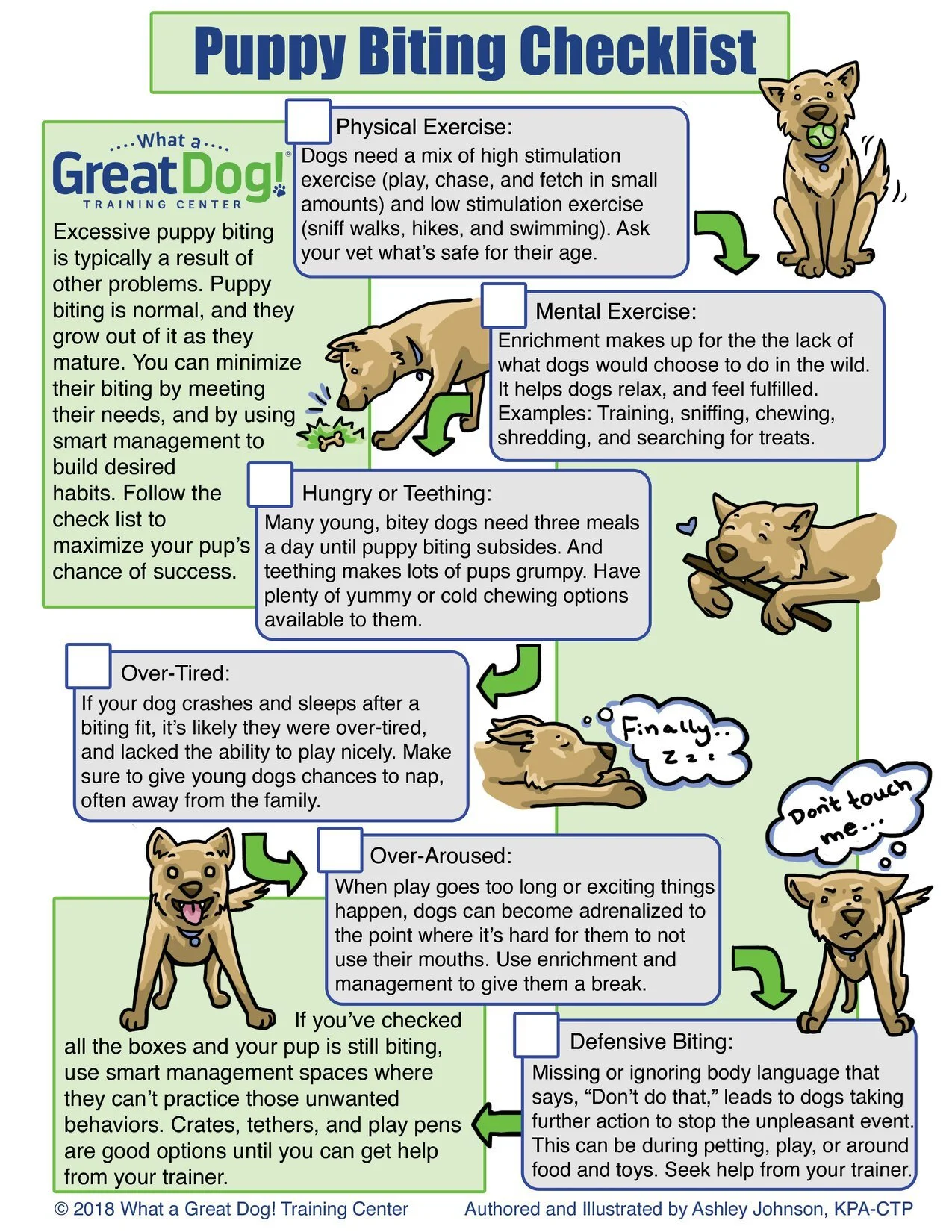 Does your puppy get all it needs? A big one is "over-tired" as your puppy needs to rest 18-20 hours per day and should never be up for long periods at a time.
When walking, puppy keeps attacking dressing gown, slippers or skirts. What should I do?
It's hard for our puppies to not react to quick moving things like that, but we can teach them.
1. While walking have some treats with you and every step you take you drop a treat next to you. Now puppy is getting used to the movements without reacting to them.
2. Once puppy is doing a great job with that, you can drop a treat every second step and after a few more days every third step and extend it further over time until you don't need it anymore.
If puppy is a particularly highly aroused, you may occassionally have to bring the technique back until puppy has outgrown that crazy, nippy stage.
You can use this technique to teach puppy in general to ignore clothes.
Puppy is biting/tugging socks, shoes, laces and pants while we are trying to put them on.
Absolutely. It's difficult for the puppy to understand that's not a game. But we can teach them. There is different ways of doing this and all of them have in common that we are setting the puppy up for success. They can be combined as well.
Puppy needs to watch you calmly while you are putting on your clothes to get used to it and find it less triggering. These are some ideas on how to achieve this:
1. Puppy can be in the crate watch from there.
2. Puppy can be eating a chewie or a filled food toy while watching you.
3. A second family member can feed puppy a treat everytime they look at you while you are tying your shoes.
4. You can deliver the treats yourself into a snuffle mat, anytime the puppy looks at you.
All of these need to be done on a distance that the puppy can handle well. Gradually decrease the distance.
Puppy is crazy first thing in the morning – biting and jumping.
Your puppy is very highly aroused in the morning. First of all make an effort generally to not amp your puppy up when you are reuniting (coming home and so on). Ignore puppy until more settled before saying hi. In the morning however your puppy is usually busting to go toilet, so it's not advisable to ignore them until they are calm. Instead you could lay a trail of breakfast from the crate to the lawn where there are some pieces scattered around. That way puppy keeps their attention on the ground rather than jumping and nipping and has something to do that takes the initial excitement away whilst also getting a chance to go toilet. Once pup is done with that you can calmly go on their level and say hi. If they are still too crazy, just remove yourself and wait until puppy calms down further. Reinforce calmness!
Puppy bites during play.
If this is occuring we want to put a few things in place:
1. Keep play sessions short - 2-5 mins max! If we go for longer we risk overstimulating our pups which can lead to nipping.
2. Don't engage in rough/wrestle play without a toy.
3. Always keep a toy between your hand and your pups mouth. We recommend a long fabric or rubber ring toy like the tug rings or long tug sets to help keep your hand as far away as possible from their mouths while playing.
5. If your puppy nips at any point, stand up and stop the play session. This shows our pup that if they make contact with our skin, the fun will stop.
My puppy is just constantly wound up.
If your puppy is getting their much needed rest (click enter in the browser or just copy this link if it doesn't open automatically) and yet is still very hyper, it is likely that overstimulation is at play. Jumping and biting harder than usual is common in puppies who are getting overwhelmed from their environment, and don't have the skills to soothe themselves yet. Moving things can also be irresistible to a tired and overstimulated pup!
We recommend you check out these resources on stress to help you through:
- Cortisol - the stress hormone
- Trigger Stacking
Teach your pup how to self-soothe by facilitating lots of sniffing, licking, and chewing throughout their day. These behaviours are all physiologically beneficial and calming for dogs. When you've found a good baseline, you can start practicing engaging them in an exciting activity to have fun, before giving them something soothing like a chewy, lickimat or treat scatter in the yard. This will give them opportunities to practice de-escalation after excitement.
Jot down times of day when they are at their 'worst' to determine if there is a pattern, and organise self-soothing activities to improve their behaviour.
You can also check out this resource to further your knowledge of dog body language.
You will find more ideas and resources on our Sit Happens NZ Whānau page on Facebook.
My puppy nips even though he has just had a nap.
When puppy first gets up after a rest it is good to give them something to snuffle for on the lawn and/or practice a bit of play and training after they have been toilet to help focus their energy on something constructive, then pop on the lead and let them settle with you for a bit. We can use our default settle exercise to help with this (located in your week 2 puppy class email). So, be sure to reward calmness.
Always be sure to read their body language as well. If your pup is not into cuddling in that moment, they will be communicating it in various different ways (moving away, wriggling, nipping, etc.) and you may need to leave them be rather than having a cuddle. There will always be time for cuddles later on when they are in the mood! Avoid going over their head with your hand.
Will my puppy outgrow chewing and stealing things that aren't his?
In any training journey, we must begin with 100% management and 0% training. Over time as we do more training, we can gradually decrease the amount of management in place, while still setting our pups/dogs up for success.
When it comes to chewing and stealing things, it is a behaviour that dogs do outgrow eventually, but only if they are not allowed to practice it.
This means utilising baby gates, long term confinement areas, crates and puppy proofed rooms and areas while our dogs are still going through this stage in their life. It is important to remember that our puppies explore the world with their mouths, and if allowed the opportunity to do this, they absolutely will.
It is our job to provide 100% supervision while they are out of their puppy proofed area, so that if they do pick something up, we can intervene and distract them with something more constructive to do instead. If you are not able to provide this, especially while looking after kids, cooking, working, etc, It is important to have your pup in a puppy proofed area for your peace of mind and so they don’t get to practice any chewing behaviours on things that aren’t their own toys.
I thought my puppy had learned not to chew the things in the house and then I came home to a war field.
It really is about setting your pup up for success. They won't be ready for the freedom of the house yet when they are still puppies. The soonest we would recommend to give them more freedom is around the age of maturity. With small dogs that's about at the age of 1 year. With really big dogs it can be about 3 years.
That's the time where you can slowly go away from 100% supervision (puppy is either in crate or in puppy proof longterm confinement area) and introduce some freedom in the house. A good idea is to start with short periods, maybe after the dog has been for a walk. If your dog proves trustworthy you can gradually increase the alone times.
Some dogs are ready sooner than others, but always go at your dog's pace.
When can I stop having to keep all things out of puppy reach?
You can introduce things back in slowly. For instance once puppy is mentally satisfied through sniffing, walks, play, training, etc. leave your shoes laying around. You are still there to call the puppy away if they show too much interest, but most likely they won't. This way you can gradually make those things part of the "furniture". However, just cause your puppy didn't chew the shoe this time does not mean, it's all sorted now. Just like with everything it takes time and repetition.
My puppy keeps stealing things and runs off with them. How do I stop this?
Your puppy would have learned the running off because you or a family member chased them. That's fun, so reinforcing.
Make your house puppy proof, so nothing is lying around that can be stolen. If your management has failed and puppy found something anyways, pretend you are not seeing it. Instead go back to your reflex exercise that you learnt in the seminar. Given you are doing the exercise about 40 times per day, your puppy won't learn that stealing things means treats.
Only pick the item up once puppy is not watching or thinking about it.
If it's something dangerous of course you may need to corner your puppy and get it out of their mouth, but given the huge trust breach that would mean, that should only be the case if you do not have another choice. If you have taught your puppy not to fear you and offer things to you, you will never have to do this. If you do have to do it, follow it up with the biggest treat party and praise ever.
My puppy keeps digging. How do I deal with this?
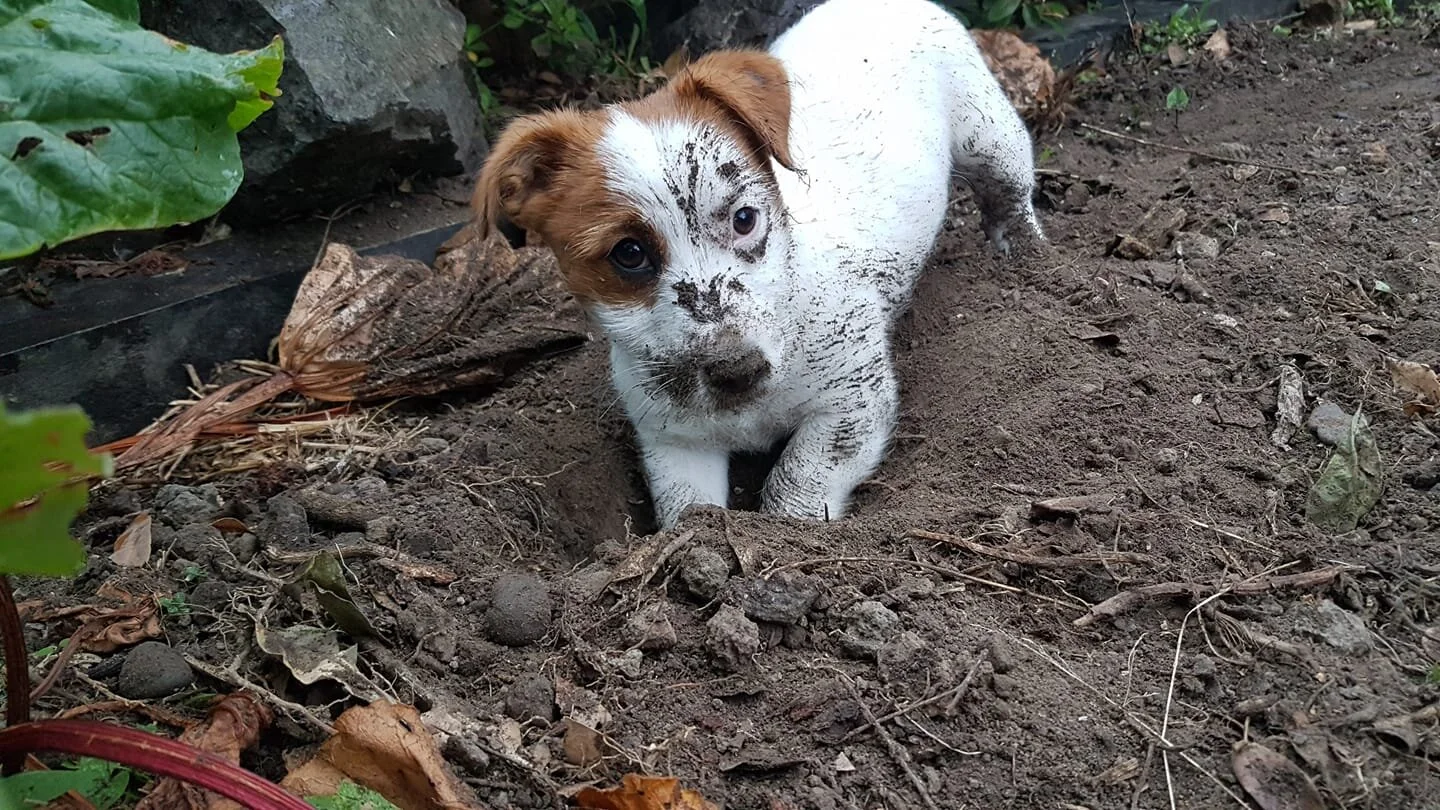 1. If it’s stress related, your dog is likely better off being kept inside.
2. If your dog just enjoys digging, build him a sandbox!
3. Don't let your puppy watch you garden as they will mimic your digging and might even help retrieve those roots and bulbs later on.
Pup thinks bed is a chew toy
Firstly we need to determine whether your puppy chews their bed because they are stressed or bored or overstimulated or just because it's fun.
If it's stress related, please thoroughly study our section: 'Confinement Areas (Crate/Kennel)'.
If it's boredom related, please thoroughly study our section: 'Enrichment'.
If it's related to overstimulation, please thoroughly study the question 'How much rest time do dogs need?' in our section 'Ethics, Mental Health & Wellbeing'.
If pup does it just 'cause it's fun, we want to work on reinforcing non-chewing behaviours on the bed, for example, give them a yummy meaty chewie or Lickimat or Kong on their bed instead, and give them other toys to play with instead of their bed.
While that training is in progress consider using a sturdy covered mattress or a soft blanket in their crate as well and don't invest into fancy dog beds quite yet as they are full of stuffing.
If pup is wanting to engage in “de-stuffing” behaviours, you could provide them with a toy like this one here, where that urge to de-stuff is directed elsewhere in a constructive way, and reinforced.
My puppy suckles on their blanket. Is that okay?
 Some dogs/pups will often engage in this behaviour for comfort. It could be that they were taken too early from mum or for another reason didn't get weaned properly.
If they like to suckle, let them and provide them with a soft blanket that they are allowed to suckle. You can just buy one and cut it into 1sqm pieces, so you can replace them over time if they get holes, etc.
But also monitor when the pup feels the need to search for comfort. Is there something in the day that can be changed to make pup more happy/relaxed? This could be as simple as giving them outlets to do “doggy things” like sniffing, licking and chewing, which are all calming behaviours for our dogs.
Digging in their water bowl
There can be a range of reasons why pups dig in their water bowl. Sometimes they are just having fun and exploring as puppies will, they want to cool down, or they prefer to drink from moving water. If your dog likes to chase things, it can sometimes be from seeing a reflection in the bottom of the bowl.
If they are responding to reflections in the bottom of a shiny bowl (usually stainless steel), try swapping the bowl out for one that doesn’t reflect anything (a darker colour or different type of bowl) and see if this helps. If your pup likes to drink from moving water, you could get a water fountain made specifically for dogs. If they want to lay in it, you could provide them with a pool (kiddie sand pit shells are a favourite) full of water for them to play in while supervised.
You can also raise the bowl and secure it to make it trickier for them to put their paws in and dig but they are still able reach with their mouths. This is a behaviour most dogs grow out of, but some will continue to love digging in water as they grow up.
How do I stop my dog from bolting out the door?
Dogs learn quickly if we can show them that the reward they want appears when they are behaving correctly, and disappears when they are behaving incorrectly.
In training we often tend to leave the reward regardless, and use restraint to keep the dog from reaching it - eg holding the collar of a dog that bolts out the door.
If we instead close the door when the dog advances towards it, and open it when he stands back without talking to or restraining him, he can much better understand how his own action can get him what he wants (or not).
Take yourself out of the equation and make it as clear to your dog as possible that he himself can control his rewards!
How to do this:
Have your dog on a loose leash (preferably attached to a harness). This is only for safety if you are working with an outside gate. Keep hold of the leash at all times but keep it loose. The gate is used as the barrier in this situation. This works best using a gate that opens out away from you.
1. Open the gate a few centimetres, if your dog rushes to push through, close it gently so they can’t get through.
2. Repeat several times until your dog is hanging back and waiting calmly while you open the gate slightly.
3. Start opening the gate slightly further each time, shutting it if your dog tries to move through.
4. Repeat until you can have the gate wide open with your dog waiting calmly.
5. Give a release cue such as “go through” or “okay” and walk through the gate and encourage your dog to come with you.
6. In this situation, the access to the other side of the gate is the reward for your dog after being released, however, you can toss a treat through the gate after using your release cue the first couple of times to encourage your dog to go through once they hear the cue.
7. Practise each time you go through a gate leading off your property! Always use your release cue if you need/want them to cross the boundary.
My pup keeps jumping on the couch and/or the bed.
It is up to you what rule you'd like to implement. We recommend to decide on a rule straight at the beginning rather than being slack at first and then trying to implement boundaries later on.
Our recommendation would be that you make these furniture items “invite-only” if you choose to allow your pup on them.
When implementing the “invite-only” rule for the couch or bed we recommend to introduce a visual cue such as a blanket that only comes out when they are allowed up onto the couch/bed.
It is important your pup does not have access to the couch or bed while you are not around, as they will be likely to get up and snuggle in while you aren’t around which is very rewarding to them.
You also want to make sure to have a comfy doggy bed or blanket next to the couch/bed where they can curl up, and reward them for being on this.
If puppy jumps up onto the couch/bed when they are not invited, say a cue such as “off” (this must be different from all other cues you use, e.g. not 'down') then gently take your pup off the couch either by encouragement or by picking them up or leading them calmly by the collar or harness. If your puppy is uncomfortable with your chosen method, please change the method or ask us for help. It is important to understand that their removal should not feel punishing to them.
If pup jumps up again pretty much instantly, place them calmly in their crate for a few seconds to reset their brain away from jumping up on the furniture. When they come out, you could give them a filled Kong or something similar on their bed to reinforce them for being there.
Once your pup is not trying to get up and you wish to have them up, bring out their special blanket (you can let them watch you to make it even more obvious) and place it on the couch/bed, and invite them up. This can be done by encouragement and can also be given a cue word such as “up” and a tap on the furniture item. Remove their blanket once their time up on the couch/bed is finished, and put it away.
My puppy constantly jumps up on us/other people.
Remember, your dog behaves in ways that they find rewarding. Our job is to incentivise other behaviour, such as standing or sitting calmly for attention, in order to replace undesirable behaviour. With consistency in your training and good management, you will be able to help your dog to keep their paws on the floor to be polite within a relatively short amount of time.
Manage the environment:
- It is so important that your dog is set up for success by minimising their opportunities to jump on people. Our training will go so much faster if they aren’t able to practice this unwanted behaviour. This means using leads, crates, pens and gates wherever possible; if you have two people, you can use leads to ensure they don’t rush or jump on guests at the door; if you don’t, you can utilise gates, pens, and crates to the same effect.
- Don’t open the door to a jumping dog. If possible, put a pen around your front door to prevent them from jumping on you when you come home.
- Tell people how you want them to greet your dog - don't let people decide for you! If your dog is unable to contain their excitement and is likely to jump, you will need to prevent them from interacting with that person. Either keep them on lead at an appropriate distance, or put them away for a few minutes to calm down then try again.
- Your dog may initially get frustrated with your management tools. Reduce their frustrations by pairing your management tools with calming, engaging things they can do instead of jumping on you (e.g. Kongs, Snuffle Mats, LickiMats, ‘find it’ activities etc.)
- Management is only one piece of the puzzle; training your dog is the next step, and is absolutely achievable.
- 1) Stand somewhere your dog cannot jump on you (e.g. on the other side of a baby gate or puppy fence, on a lead being handled by someone else).
- 2) Ignore your dog every time they jump towards you by turning to the side and looking away.
- 3) In the moment they have all four paws on the floor, mark with a ‘yes!’ and deliver a treat straight into their mouth. It is important to deliver the treat down and towards them, almost under their chin, so they are not tempted to jump up for it.
- 4) Mark and reward them in quick succession to minimise their opportunities to jump.
- 5) Slowly build up the duration they can keep all fours on the floor before getting rewards, half a second at a time at their pace.
- 6) When they are no longer scrambling to get to you, you can scatter treats (or throw a Kong) away from your entry point and tell them to ‘find it!’, encouraging them to pursue a quiet activity while you enter.
- 7) Be ready to deliver treats straight into their mouths as they come towards you before they get the chance to jump on you.
- 8) Take the time to mark and reward the paws on the floor behaviour during quiet times as well.
Train your dog to go on their mat when people come over: We can teach our dogs proper visitor behaviour:
whenever the doorbell rings they lay down on a certain spot and wait there until they are calm and we release them. https://youtu.be/mWdttqEGn3c
Doing mat training and visitor training will change how your dog perceives and responds to visitors when they arrive at your home, and after they come inside. Having a calm, clear expectation and helping your dog learn this skill will make the world of difference for dogs who get over excited around people.
Download a Sign for your door here.
There are cases where dogs jump up because they are over-aroused and need quiet time. There are indeed times it is very appropriate to use quiet time, which we highly encourage pairing with a licky food toy and other things your dog may find calming or comforting.
Your dog will go through an ‘extinction’ period, where their jumping will steadily decrease. Sometimes there is an ‘extinction burst’, where your dog will suddenly start jumping with even more vigour than before. Don’t stress - this is a last ditch effort to test their jumping as a way of getting rewards. Stay consistent.
Watch this for some more advice.
My puppy has started humping things around the house. How do I stop this?
Humping is usually a behaviour that comes out when over-aroused/over-excited and/or when they reach sexual maturity (usually around 6 months for smaller breeds, closer to 1 year for bigger breeds) when extra hormones are rushing around their bodies!
1. First and foremost make sure they are getting enough rest/sleep! Remember young dogs require huge amounts of rest (18-20 hours per day!).
2. Utilise your reflex to name exercise for these times when you need a distraction.
3. Keep up the reflex to name (Announce name, immediately pop a treat in his mouth) 40-50 times per day, then the once or twice you may have to use this for distraction when they are humping, your pup will not make the association that humping = reward.
4. Use the reflex to name 3-4 times in a row to lure them away from whatever he is humping and replace it with something better.
5. Ask yourself: Is my pup hyped up? Do they need a rest? Are they overwhelmed by something? Does it happen certain times of the day? etc.
If it helps, you can keep a diary of when it happens and what happened before they started humping (exciting play session, etc) and it might help you to understand their triggers for starting the humping, then we can put management techniques in place to avoid this from beginning.
Something to note is, while we definitely do not want our puppies to hump humans or other dogs, we don't mind too much if they only hump their own toys as this is just high arousal and they will usually outgrow this.

Why we never tell a puppy off for toileting inside
We never ever tell a puppy off for accidentally going to the toilet inside. It is our job to make sure our puppy has sufficient opportunities to toilet in the correct place (outside) and it is never our puppy’s fault if they have an accident, as it is just that!
It is important to remember our puppies are small and young and as a result do not have good bladder control. This takes time, maturity and good habits to develop.
If we tell a puppy off for toileting inside it is extremely scary for them as they will not understand what is happening or why you are angry at them. You also risk the puppy associating that toileting in front of you results in being told off which often leads to the puppy trying to hide their business from you or even avoiding going to the toilet while you are with them outside.
What to do if my puppy urinates submissively when greeting people?
The video below covers how to train and prevent your puppy or adult dog from urinating when greeting a family member, friend or stranger. Some puppies will grow out of this behaviour, but for others the behaviour can continue into adulthood.
The most important concept to remember is to try and keep your cool if your dog does urinate even though it can feel frustrating and embarrassing especially if the dog pees on the guest’s shoe, something expensive or hard to clean. The problem with acting frustrated or angry is that it will make the dog more likely to submissively pee when greeting you the next time as greeting predicts the person getting angry.
The first plan of action is preventing the behaviour from happening by “changing the picture”. All dogs are different and have different stimuli trigger them to urinate. For some dogs it’s even simply the sight of their owner coming through the door after work.
Here is a list of things that can trigger submissive urination:
- The dog has not seen the person for a long time
- A direct approach
- Direct eye contact
- Standing directly in front of the dog
- Leaning over the dog
- Touching the dog – calmly, excitedly or playfully
- Talking to the dog – normally, in a high pitched voice or loud
What you can do instead:
- Wait until the dog has had time to calm down before interacting
- Let the dog approach you rather than approaching the dog
- Avoid a direct approach by walking in an arc toward the dog if you approach
- Avoid direct eye contact and blink at the dog if you do look at the dog
- Stand facing to the side when near the dog
- Don’t lean over, pet or talk to the dog until the dog has had enough time to calm down.
- Pet the dog with the dog at your side rather than directly in front of you.
- Move calmly and slowly.
- Immediately stop interacting with the dog and walk away if you see the dog start to lower their hips, squat or roll over.
Submissive urination is usually more likely to happen during the initial meeting after not seeing the person for a long time or meeting a new person. What you can do is change the dog’s expectation of what will happen during the initial meeting. Instead of what typically happens, an immediate social interaction upon seeing the person, you can make the initial appearance of the person predict something else, for example, being fed, working for treats or getting to go out to go to the bathroom.
With family members
When arriving home, you can change your dog’s motivation by dropping treats on the floor or giving the dog a high value chew. You can also make the initial meeting about going outside to go to the bathroom. Instead of saying “HI!!! FLUFFY!!!” You can open the door and in a casual voice say, “Do you need to go out?” and without looking at your dog walk around your yard looking interested in the bushes or places in the grass. If your dog jumps on you, you can also do this but sprinkle treats in the grass to point out to your dog to get your dog interested in sniffing around.
After your dog has calmed down, say 10 mins after you get home, you can then give your dog the excited attention you wanted to when first seeing your dog. This works great for family members who get over-excited by their dogs, as it gives them also a chance to calm down before interacting with the dog.
With guests
Have your dog on a leash and harness or in a pen and let your dog calm down first before getting to greet the person. You can give your dog treats for settling on his dog bed.
Instead of jumping right into petting, have the guests feed your dog a treat to change the dog’s motivation from greeting to expecting food. You could also get the person to ask your dog for his favorite behaviors or tricks. After each behavior the dog can receive a treat from the person.
You can teach your dog to touch the person’s hand (which we will practise in week 3) or rest chin in the person’s hand as a behavior so the dog is touching the person at first rather than the person touching the dog.
Ask the guest to stop petting your dog and move away from your dog if you see your dog start to lower his hips, squat or begin to roll over.
Watch here the video on what you just read.
I thought my puppy was toilet trained, but even though the door is wide open I find puddles inside.
Leaving the door open can actually hinder the toilet training progress as you are firstly not there to praise your puppy for going outside and secondly you don't know when they have or haven't gone, so you can't manage it. It's better to set an alarm on your phone and bring puppy outside regularly. After a few days you will know if it needs to be every 30 minutes or if every 90 minutes is enough with your puppy.
Just cause they got it right a few times doesn't mean they are toilet trained. Keep the success up for a bit longer as your puppy will need to get to the point where they ask you to open the door. That can take a while as the urge to not toilet inside will increase with not doing it for a while.
Will my puppy eventually let me know when they need to go outside to the toilet? Can I teach them a certain way to do this?
Every puppy is different, some puppies will show subtle signs of needing to go toilet very early on (5-6 months) however, it can take dogs until maturity (closer to 1 year) to develop proper signaling techniques. The more a puppy goes outside to the toilet, the stronger this urge will get. If they are still having accidents inside, they are not quite there yet, and it is unlikely they will indicate they need to go outside.
The urge to go outside needs to be strong for a puppy or dog to indicate. This will grow stronger the less accidents they have inside and the stronger their reinforcement history is for toileting outside in the correct place. Please remember puppies take time to gain good control over their bladders and bowels!
Things that can help encourage puppies to indicate:
taking the puppy out the same way to the toilet each time, this will provide them with consistency of where you would like them to indicate
reinforcing your puppy for going outside (try a tasty treat they enjoy once they have finished toileting)
when home, keep working on your toilet training, rather than leaving your pup to toilet inside on things like pee pad, paper or grass mats (keep the use of these for your puppy’s long term confinement area when you are not home to take your pup outside to toilet)
make sure you keep consistent with your toilet training, even when you think your pup understands – often puppies regress in their toilet training when guardians become more relaxed
Oftentimes pups will quietly sit or lay by the door when they need to go and it's important we don't miss those signs. The more this is working for them, the bigger their urge will get to be noticed rather than just going inside. Overt ime they will learn to bark, whine, pace by the door o scratch at the door, for instance. If reinforced, they will continue to use these ways of indicating.
You can also teach your pup a more prefered way of indicating if you like:
A popular way of teaching a puppy to indicate to go outside is by using a bell that's attached next to the door or hung from the door knob.
After we have taught our puppies the “touch” cue in class, we can use and shape this to begin to teach our puppies how to ring the bell with their nose:
1. Ensure your touch cue is solid.
2. Teach them to target an object with their nose (use an object different to the bell you want to use otherwise your pup may learn that ringing the bell means treat rather than ringing the bell means open door).
3. To help puppies understand the game we can transfer the touch skill from our hand to object by using a post-it note on our hand, then transferring the post-it to another object.
4. Generalise targeting an object to a few different objects.
5. Place the bell at your door and before opening the door ask your pup to target the bell, mark with a “yes” and reward them, then open the door and take them outside.
6. Continue to reward your pup after toileting to ensure that is part of the connection.
If you would like your puppy to use their paw to ring the bell, we would teach them to target with their paw instead of their nose, but be mindful that they might sometimes scratch your door.
Please make sure whatever bell you choose is one that is easy for your puppy to ring, so they don’t get frustrated!
Happy ringing :D
How do I get my puppy up and outside to the toilet when they are comfy and don’t want to move (at night)?
Make sure that you are upbeat about the routine and announce to your pup with a happy, excited voice what's about to happen. Most pups will just happily go outside with you when that is the case. Some pups however really like their comfort and need a bit more encouragement. That's okay, just be patient with them while they are learning.
Get yourself equipped with your treat pouch and start a little training session. Kneel down next to them and work on your 'touch' training that you learned in class. Have your puppy do some super easy ones where they barely have to move to touch your hand, and reward handsomely with super tasty treats, then ask for ones where puppy has to get up slightly to touch, until they have to fully get up and move towards your hand to touch it successfully. Start easy and small, they will be motivated soon enough if your reward is worth it!
If your puppy has a collar or harness on, you could attach a leash and gently encourage them using your “let’s go!” cue if you have taught them this already (week 3 of class!) as this can become a cue to your pup you are moving somewhere together. Make sure you don’t pull them, as this will probably make them resist more and brace against it. Again, reward them well once they get up.
A common mistake guardians make is to just reach for their pup or try to lift them up. This can be quite confronting/scary for a pup when they are in their comfort/tired/safe space and can lead to growling and snapping, so please take the time to teach your pup a good routine instead and it will require less and less effort and treats over time.
Be sure to reward your pup in their crate with a little chew or yummy treat after their outside toilet stop.
My puppy won’t go to the toilet outside when I take them out, but immediately goes on the floor when I bring them back inside. What should I do?
This is typical for puppies who are still learning toilet training. Especially when it is cold or wet outside! For puppies who do this;
1. Take pup outside onto their toileting area give the cue you use to encourage them to toilet (eg. Something like “Be quick” or “Go toilet”).
2. Wait a minute or two and if puppy doesn’t go, pick them up and take them back inside and place them in their crate. Carrying the puppy (if small enough) is important so that they don’t have the opportunity to toilet on the way to the crate.
3. Leave pup in their crate for 5 minutes, then carry them back outside to their toileting area and repeat their toilet cue.
If puppy still does not go, repeat this whole process until they do. Wait till the puppy is TOTALLY finished (getting up and stepping away) and give a yummy treat and lots of praise!
My puppy toilets in their crate overnight or wakes us up crying to take them outside to the toilet.
1. Take pup's water access away 1-2 hours before they go out for the last time at night before bed (unless they starts zooming around and gets thirsty, then offer water, but understand that might be a night they might need to pee more frequently)
2. Take your pup out to toilet JUST before you want to go to bed yourselves - make sure they toilet at this time before popping them in their crate
3. Set an alarm to wake you up to take puppy outside.
If you are already doing this and they are waking up again during the night, go back to toileting them more than once per night.
4. If pup wakes up and begins to cry/howl at a specific time, make sure you set and alarm and get up BEFORE they begin to cry/howl.
Once they are being super successful at toileting at these times and is not acting like they are busting each time, we can start to increase the time by 15 mins each night. For example if you get up at 1:30am, and 4:30am, the next few nights could be 1:45am and 4:45am. Keep pushing it out in small increments until you are only getting up once per night. Make sure you are setting them up to be successful.
The reason we want to get up before the crying/howling is so that they don't learn that howling make their humans get up and come to them, so we want to get up and wake them up and take them outside on our terms, so that they don't have a chance to start howling.
Remember that puppies are young and small! The smaller they are the more trouble they have holding on due to having a smaller bladder!
It may just take a wee bit longer to start being able to hold on for longer. As they get older they will start being able to hold on longer.
Is it normal for a puppy's toilet training to regress on rainy/cold days?
Yes! Just like us, puppies usually aren't the biggest fans of rainy and/or cold days! They are less likely to want to spend time outside and also less likely to want to toilet on the cold and wet grass.
Important things to remember to avoid this from happening:
1. Take your puppy out just as frequently as you would on a fine day. Or more often if they refuse to go. You need to stay out there with them, so you don't miss the moment to reward.
2. Ensure your puppy has toileted before bringing them in and allowing them to run free outside of their crate or long term confinement area. However, don't wait around forever: if they don't go, go back inside and put puppy in its crate. Try again a bit later. And repeat as often as needed.
3. Get your puppy used to a "toileting cue". If they know what is expected of them, it can help make a trip outside quick and successful on those days the weather isn't so good.
4. If your dog is short-haired, feels the cold or it is raining hard, they might benefit from wearing a warm doggy coat outside. They appreciate having an extra layer on sometimes just like we do! You could even use an umbrella to keep the rain off if your pup is comfortable with it.
5. When you get a successful wee in the rain, make the 'running back inside' part of the reward. You can throw a treat party there.
Do I have to keep giving my puppy treats for every time they do as I ask them to?
Treats are great to use when teaching a new behaviour! You want to start with a Continuous Reinforcement schedule which means EVERY TIME your pup responds correctly they get a reward.
Continuous reinforcement allows a high rate of reinforcers to be presented which keeps the pup highly interested and the frustration level low. Continuous reinforcement makes the newly learned behaviour resistant to change. Once the behaviour is offered in a timely and CONSISTENT manner in response to the cue, you can change the Reinforcement Schedule. Again, we do this once the pup is FLUENT in the behaviour (8 out of 10 correct responses in different environments).
You can now start rewarding just the best responses (criteria could be speed or preciseness for example), BUT you need to make sure your standards are right. Be aware that if you do not maintain a high enough rate of reinforcement for the MAJORITY of the time, the behaviour will cease to be offered by the dog. So, make sure to raise your standards slowly. Find out what your pup finds rewarding. At the end of the day, that doesn't just have to be treats. Toys are my favourite and I hope you work on getting your pup super duper keen. But pats and praise also cut it for some pups in certain situations. The higher the distractions, the higher value the reward needs to be. It is recommended to keep the reinforcement for the Recall, your 'COME' cue, incredibly high!
Please note: We only say "YES" in training context, not in everyday life. If we do say yes a treat always follows, but we can of course also treat without having said yes if we are with our dogs outside of training context.
My puppy is doing so well with training, but as soon as we are out and about it's as if they forgot everything.
Dogs can’t generalise well. This explains why owners often say their dogs are stubborn. “He knows the ‘sit’, but won’t do it in the park”. Watch [here](https://www.youtube.com/watch?v=E-SX6H_9hPc) why.
**Add distractions and different settings:**
- When you begin training your dog to do something new, you usually start off in an area that's fairly quiet with very low distraction. Once your dog is able to respond quickly to a command in this setting, it is time to add some distractions and new settings. Do this slowly, and work on adding one new thing at a time.
- Let's look then at how you would proof a "down." Practice the down until your dog is able to respond to the down command fairly quickly. Then begin to slowly add new things. You can start by adding some distraction. Have another family member come into the room. Practice several times, and then turn on the television while you practice the down. Slowly add more distracting things to his environment, like other dogs, running children, and loud noises. Do all this while practicing the down.
- Once your dog is able to lie down quickly on command with some distraction, begin practicing in different places, such as another room, the backyard, and the neighbour's house. Keep each training session to about 10 minutes, and stay upbeat. If your dog begins making mistakes, go back to the last time he was responding quickly to the command.
- After you have practiced a behaviour with different amounts of distraction and in a variety of locations, your dog should have a really good grasp of the behaviour.
- He should now be able to perform the behaviour as well at the dog park as he does it in your living room. Once you've gotten to this point, the behaviour is proofed!
**Some broadly helpful tips for all training if your dog is struggling to keep up include:**
- Increase the value of their rewards so they have something exciting to spur them on
- Practice consistently, yet at a pace your dog is happy with
- Treat training like playtime – act bright, cheerful enthusiastic and offer plenty of encouragement at all times.
**Here are some more specific tips for proofing that you could also try out:**
- Before moving to a new environment, practice the behaviour in the environment your dog initially learned it. This will ensure that the cue and the behaviour are at the forefront of their mind
- When you do move to a new environment, lower the standard at which you expect the behaviour to be performed at – offer praise and reward if they offer the correct behaviour, regardless of sloppiness
- Play attention games first to ensure your dog is in the right frame of mind and thinking fast.

Sit. Sit. SIT. sit sit sit sit. SIIIIIIIIT! Sounds familiar?
And you're not alone!
Chanting the cue is one of the most common mistakes dog parents make.
If our dog doesn't perform the cue right away, we tend to repeat it. If that doesn't work we raise our voice. We assume that the pup is either stubborn or doesn't hear us (or both)..
Do me a favor and tell me what is 64 x 125, while holding a scolding cup of water in your hand. You only have two seconds to give me an answer and you can't use a calculator.
⬆️ Oftentimes this is the equivalent level of stress our dogs are under if they're meeting a stranger or are thrown into a new environment, but asked to perform a cue that they "should already know".
Here is what is likely going through your dog's head when you ask for a "Sit-Stay" while, let's say, you're about to open the front door after the doorbell rings:
- "I'm confused by this request."
- ""Sit"... "sit"... "sit"... I know that one. Hold on, I *think* I can get this one right."
- "Not now, there's an intruder I need to deal with."
- "What's in it for me?"
- "Be careful!"
- "This is too hard."
- "Omg, WHO'S AT THE DOOR?"
- "You're scaring me."
What you should do when your dog is not responding:
💜 Give them a few seconds to process the information. They'll likely get it right when you give them time to think about it.
💜 Go back to basics and practise the behavior in environments where your dog is not distracted and has no issues performing (e.g. the living room). Then, generalise the behavior by practicing it outside the learning environment and gradually adding new distractions. You're likely asking for too much too soon.
💜 Use higher-value rewards in highly distracting environments. If you're worried about bribing your dog, then consider whether getting a paycheck and an acknowledgment from your boss for a job well done would be bribing in your book.
💜 Ask your dog for a behavior they normally have no issues performing. In a high-stress environment, executing a movement-based behavior (e.g. hand target) is easier on the nerves.
💜 Stop what you're doing, take a step back, lower your tone, and smile at your dog. They didn't get it and that is 100% okay. You can pick it up again when you are both less frustrated.
credit to Benny's Best Dog Training @bennysbestrescue
My puppy is perfect with cues when they see I have a treat but not so much when they feel there's nothing in it for them.
We want to make sure when we are training that we are using our treats as a reward and not a bribe. This means having your hands free of treats (keep them in a pocket, treat bag or up on a counter) when you cue/ask your dog to perform a behaviour, and AFTER you have marked with a “yes”, move your hand to grab a treat and bring it to your dog's nose to reward them.
This is especially important if you need to lure with a treat in one hand. Make sure the treat the dog is actually receiving as a reward after our marker word comes from the other hand and work quickly on fading out the lure.
We can start to place treats up high (where your puppy can’t get them) in little containers around the house so that when you ask your pup to do something, you can still reward straight away with a treat from a container even though it seemed to your puppy that you didn't have treats. Make sure you do this with a behaviour or trick your pup knows really well (eg. a sit or a touch).
This way, pup learns that rewards don’t always come from our pockets, so even if they can’t smell the treats on us, it is still worth offering the behaviour, because they will still be rewarded for their efforts.
If you want to, you can also simulate this outside of your home by going to the place you want to walk your dog before taking the dog with you and hiding some treats in trees and bushes, then when you walk past with your pup, you can cue a behaviour and then use those treats you have previously hidden as the reward.
Your puppy will think you are magic and it's always worthwhile to check what's in the next tree. :)
Can I just grab my puppy by the collar and move them around on it?
It is important to get the pups used to being grabbed by the collar, especially also cause strangers might sometimes do this. Watch [here](https://youtu.be/U8EAUL4-hFs) how to train this.
How long should a training session last?
Remember to keep training sessions short with your pups.
Between 2-5 minutes is a good starting point. It may not sound like a long time but we need to remember they are only babies with short attention spans! As they get older and have a few cues they know well, you can start to extend the sessions slightly, but keep them to a max of 10 minutes while they are still young.
If they start to fuss/nip/walk away or get distracted during a training session, this is an indication the session has gone on too long. Don’t worry, just end the session there on a good note and come back to it later and keep in mind to keep the next session shorter.
If your pup is struggling with a particular concept, keep their motivation up by rewarding each little try!
I am training with my dog and all of a sudden they start doing something else. What is that all about?
DISPLACEMENT BEHAVIOUR is often described as the dog ignoring the owner and ‘mucking about’ or 'being stubborn', displacement is the dog's way of showing you (unconsciously) that he or she is becoming bored, stressed or simply confused. This can for example happen when we are inconsistent or asking for too much of our dogs. When it happens, stop and consider what is happening and why. Don't tell your dog off as they are not defying you. Take notice of the dog’s behaviour at all times, if he starts to show signs of displacement then you need to ensure that the approach to the training or the environment is changed so that he starts to focus for the available reinforcement. In some cases you may even need to stop the session and reconvene at a later date with a more suitable environment or training plan.
How do I stop my puppy from snatching the treat while training?
First, we want to ensure we are delivering the treat in a way that doesn’t encourage snatching. We want to produce the treat in a calm and gentle way, bringing it right to their mouth in a flat hand.
This means there are no fingers to accidentally nibble, and the dog does not have to reach or come forward to take the treat.
We want to teach our dogs to take treats gently, by first using a low value treat – something they aren’t super fussed on or their normal everyday kibble. Once they are gently taking these treats, we can gradually increase the value of the treats.
If our pup is still snatching off our hand, we can do some specific training on how to take a treat gently.
Watch here how.
Is it okay to have more than one person involved with the training?
Absolutely! Ideally, the whole family should be involved with your puppies training. However, it is important that everyone uses the same cues and methods of teaching, to prevent confusing the pup.
What should my puppy be doing while we are eating meals?
Of course your pup will want to make sure they can get their share of your yummy meal. Whilst that's understandable we don't want to encourage it. Longterm the best place for the pup to be while you are eating meals is on their mat/bed, but in the short term they won't be able to contain themselves yet.
So, in the meantime you can help them by having them in their crate or in their long term confinement area, letting them have their own meal in a puzzle toy, enrichment activity (such as a Lickimat) or munching on a meaty chewie. Remember, Dominance and Alpha Theories have been debunked, you do not need to eat before your pup!
Giving puppy their meal while you are having yours means they have something delicious to focus on while we are consuming things that smell super yummy to them, and so they are practicing good behaviours (settling and being calm) while this happens.
Do not let your puppy beg for food or feed them from the table as this will become a life-long habit that is extremely hard to break.
If you do have leftovers that you would like to share, take them away, clear the table, tidy the kitchen as you would normally and prepare a plate for your pup that you can give to them later on, unrelated to your meal.
Set them up for success now and teach them straight away what you'd like them to do longterm!
Remember that even if your pup fits under the table easily now, if they are going to be a medium sized dog or bigger, it won’t be so cute eventually!
My pup is not food motivated...
Treats are often the easiest reinforcer to train dogs with. Some dogs will eat anytime, anywhere, but most need a little extra training. If my dog can't take a treat from me at some point she likely won't be able to listen to anything else I ask her to do.
Here are some tips on how to get your dog to start taking treats more reliably.


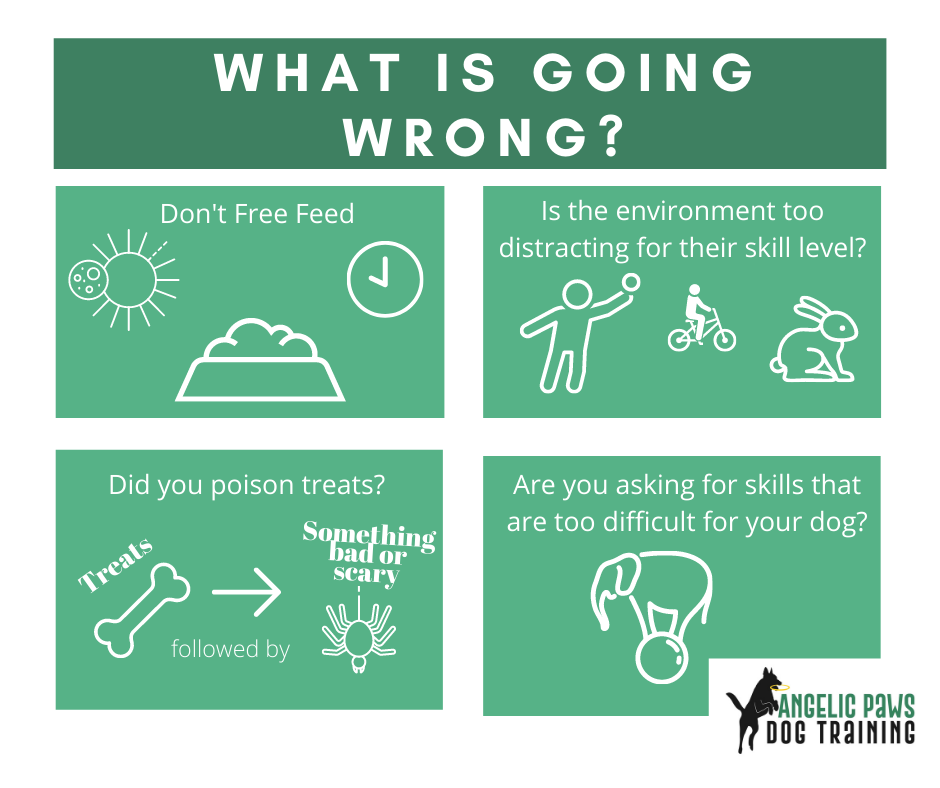
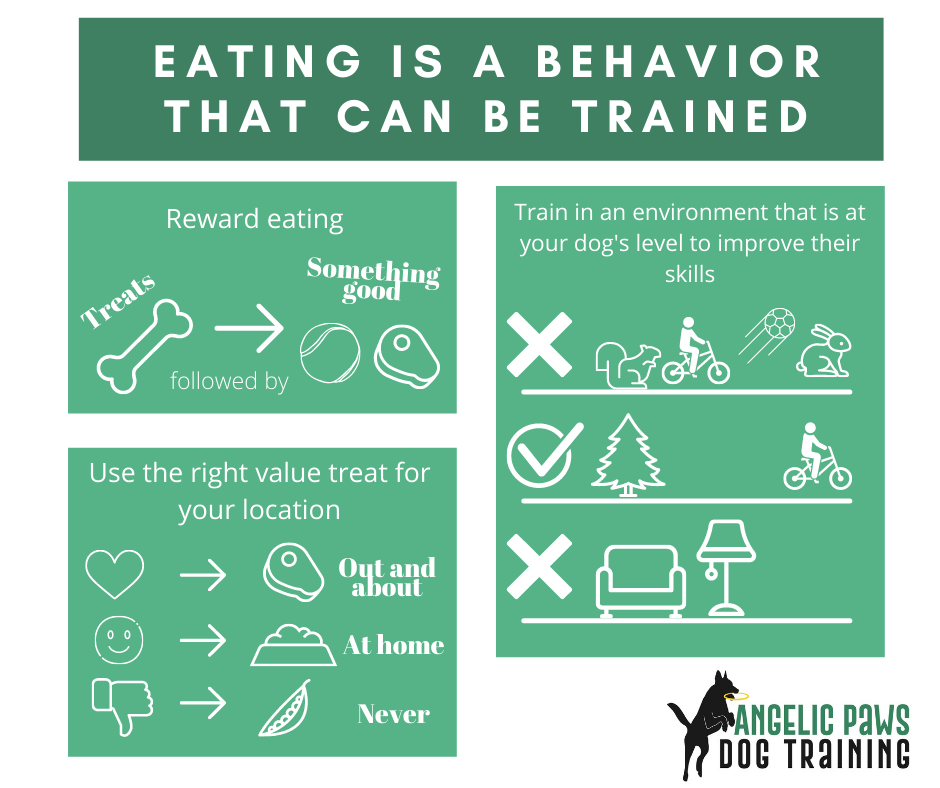
Teaching puppy to be okay with being bathed, picked up, handled, etc.
We want to get our puppy used to the area that will eventually be used for giving baths before we need to give them one. We should first introduce the bath/shower with no water to start with, make it a lovely fun area associated with nice things. We can do things like smear peanut butter (or something else they find super tasty) around the walls and let them lick it (or use the [Lickimat Splash](https://kiwicanine.co.nz/products/lickimat?variant=39728652386475) to spare your bathtub walls). Once they are happy in the area, we can gradually introduce water.
It is easy and convenient for us to pick our pups up, especially while they are small, but most dogs do not enjoy being picked up and carried. If it something we want to be able to do if necessary, we teach our puppy to be okay with this. We want to alert our pups to the fact we are picking them up before we do, so that we don’t startle them. You can use a cue like “up” and announce it before you pick them up. As you lift them up reward them, and as they stay in your arms, then place them down before they get restless. Start with very short periods of keeping them in your arms (a few seconds) before you gradually increase the time bit by bit as they get used to it and are comfortable with what is happening. Make sure when you pick them up it is comfortable for them and you are supporting them under their chest and bum. Make sure you do not lift them or place them down too quickly, as this can be a very weird and uncomfortable sensation for them – think of when you go on a rollercoaster and it drops quickly!
Ensure you practice your handling exercise lots and focus on the areas that they struggle with the most. Eventually, we want our pups so happy with handling that they offer us the area that we have announced we are going interact with. We want to practice our handling exercise for a few minutes each day for the first few weeks, and then every week for a month or so, then at least once a month. We want to continue making it a really rewarding exercise for them, that they enjoy being involved in!
When can I let my puppy off the lead?
Initially when practicing your recall, you won’t entirely “let them off the lead”. We want to be absolutely sure our recall is reliable in various different situations and places before taking them off the lead entirely. This is because we don’t want our puppies to practice running off, because they are likely going to be running towards something fun, which means them running off will be accidentally reinforced. Plus we will be shouting to get them back and poison our recall cue.
So how do we manage this?
We recommend starting them off on a 10m long line. This is so they can have more freedom while still being attached to you. Practice your recall while they are still attached but pretend they don’t have a line attached. When they are completely responsive to you while you manage the longline, you can drop the long line and allow them to drag it so you have a length of long line to pick up or stand on to stop them if needed. Think of your long line in this situation being a safety net – hopefully you won’t need it but it is there if you do!
When can I let them completely off the lead?
When you never have to pick up the long line to stop them after weeks of them being responsive to us in environments with distractions and they are recalling to you each time you ask. If you can go several weeks with never having to touch the long line, you can progress to taking it off completely.
Remember: If you take your puppy to a new and very exciting environment or they start hitting adolescence phase you may need to pop them back on the long line for a period of time to make sure your recall is really good before letting them go again.
How to teach the "Go Sniff"...
Watch [this](https://www.facebook.com/dogmantics/videos/452399432209263/) video to see how to teach the "Go Sniff" plus the recall away from sniffing.
My puppy goes deaf when we are somewhere exciting...
Set your puppy up for success:
Practise recall at home first before adding further distractions.
Use a [Long Line](https://kiwicanine.co.nz/products/long-line) to ensure they can't make a mistake. [Here](https://youtu.be/Ey_MJOYjEYQ) is a video on how to handle Long Lines.
Recalling around distractions.
Watch [here](https://youtu.be/tV5qsH5tjYA) how to start your recall training around distractions.
[Here](https://youtu.be/iIR3MtTSyIw) you will learn how to "proof" your recall around higher levels of distractions.
Tips on how to make your recall successful
One of the most important skills for your dog to have when they are off leash is returning to you when you call them, especially around potentially life-threatening distractions like chasing a cat across a busy road, approaching a fearful dog or heading towards rubbish and food scraps left on the ground.
If you are having trouble with recall when you are out, we would instead recommend to practice your recall in your backyard. Teach your puppy that when she comes to you, she gets a really great reward. You can also use your ‘TOUCH’ cue for the recall as well as that is a really fun game for our puppies.
Start practicing in a place free of distractions, like your lounge room, then gradually move to more distracting environments as your dog starts to learn to come back to you (the back yard, then the front yard, then a quiet park, then at a park with dogs at a distance).
When you start to work in more distracting environments, start with the longline at 3m, recall your puppy, and make sure you have something extra special (i.e. cooked chicken) to reward her for coming to you.
Over time you can increase the distance of the longline to 10m and when that’s really good you can start working with adding distractions as well. If your dog isn't coming back to you, the environment is too distracting - make it easier and practice more!
**Keep It Fun!** - Turn your recall practice into a game - the more fun your dog is having with you, the better your dog will learn! If your dog is losing interest, try a different and more motivating reward or take a break and try again later.
Ensure you reward your dog every time they come back to you when you call, even if they take a long time! Always reward them with something they love - a high value treat, a favourite toy and verbal praise. Never punish them for coming back to you even if they were really “naughty”, or they won't want to come back to you next time and you will undo your hard work!
Remember to go at your dog's pace - don't expect too much too soon, practice loads and soon you'll be confident that your dog will always come back to you when you call!
Recall is a big topic in Level 2 Class if you'd like to learn some more advanced techniques.
Should I let my dog sniff?
Sniffing is an important function for dogs, leaving them with a 'feel good' factor.
It's mentally stimulating and provides them with important information about their environment.
The olfactory nerves are connected to the limbic system - that is the section of the brain where emotions are processed.
Allowing your dog to sniff on walks gets them moving in different directions, giving them a full body and brain workout.
Next time you go for a walk, take it slow and let THEM lead the way. After all - whose walk is it anyway?
Puppies don't need lots of road walking. They need to go on little adventures, somewhere where they can safely be on a long line and where they can run and play and explore; then rest and sit and watch the world go by.
The leash is your emergency break, it is not the steering wheel.
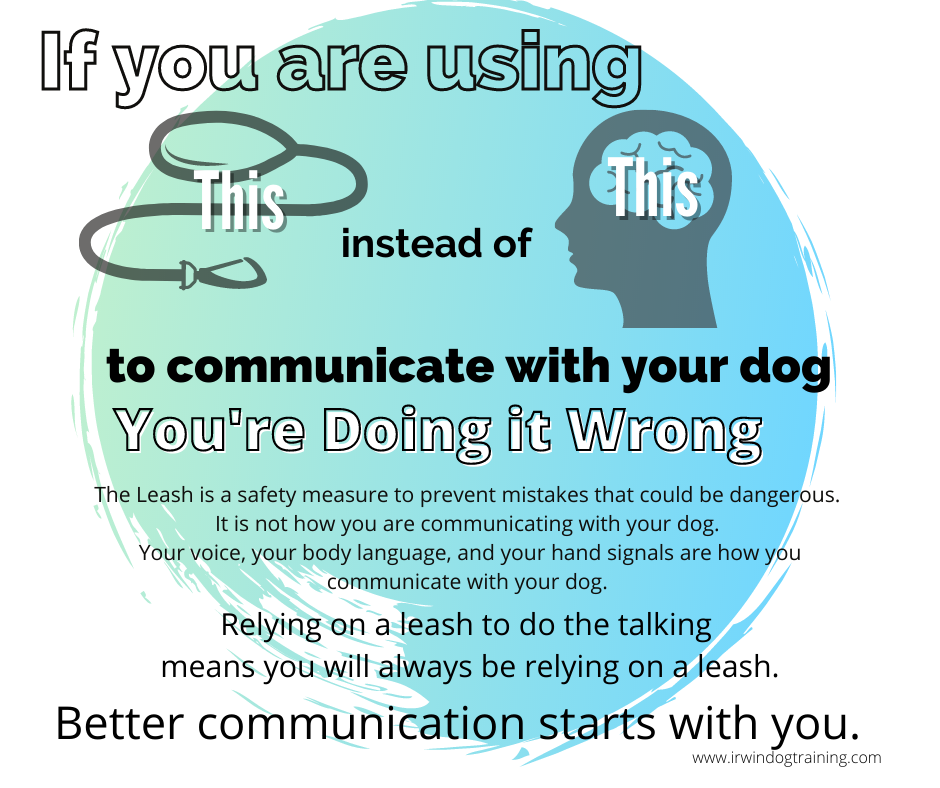
What is the purpose of your walk?
A great way to break up the monotony of doing the same walk every time is to think about WHY you’re walking your dog. What benefit would you like your dog to gain? Different styles of walks will provide you and your dog with different benefits.
The following are four good themes to follow, though some of them can be mixed in the one outing.
During a TRAINING walk you and your dog are in the learning zone; you’re practising your loose leash walking, polishing up those obedience cues and working on your latest tricks. This type of walk is great for mental enrichment, increasing your dog’s focus in distracting environments, and strengthening your relationship.
A DECOMPRESSION walk is all about Zen. No agenda, no training, just some time for you and your dog to stroll about and explore together. It’s a chance for your dog to relax from the everyday little stresses that come from being a dog in a human world. The best locations for decompression walks are places that aren’t too busy, where you can safely let your dog off leash (or on a long line) to sniff and wander where they please.
An EXERCISE walk is designed to keep your dog fit and provide an outlet for their energy. For most dogs, plodding along at a human’s walking pace isn’t much exercise. There are plenty of ways to structure an exercise walk, like sprinting, strength training exercises, weight pulling, endurance running and more. Talk to your veterinarian about an exercise routine suitable for your dog’s age, breed and fitness level.
A SOCIAL walk is an outing where your dog gets to interact with other creatures. Not every dog enjoys the same type of social interaction; there are introvert dogs and extrovert dogs. Some dogs will prefer a quiet play date with a dog or two that they know and trust. Others like playing rambunctiously with any dog they meet. Being amongst humans counts as social time too; if your dog loves watching people an outing to a café or marketplace can be lots of fun.


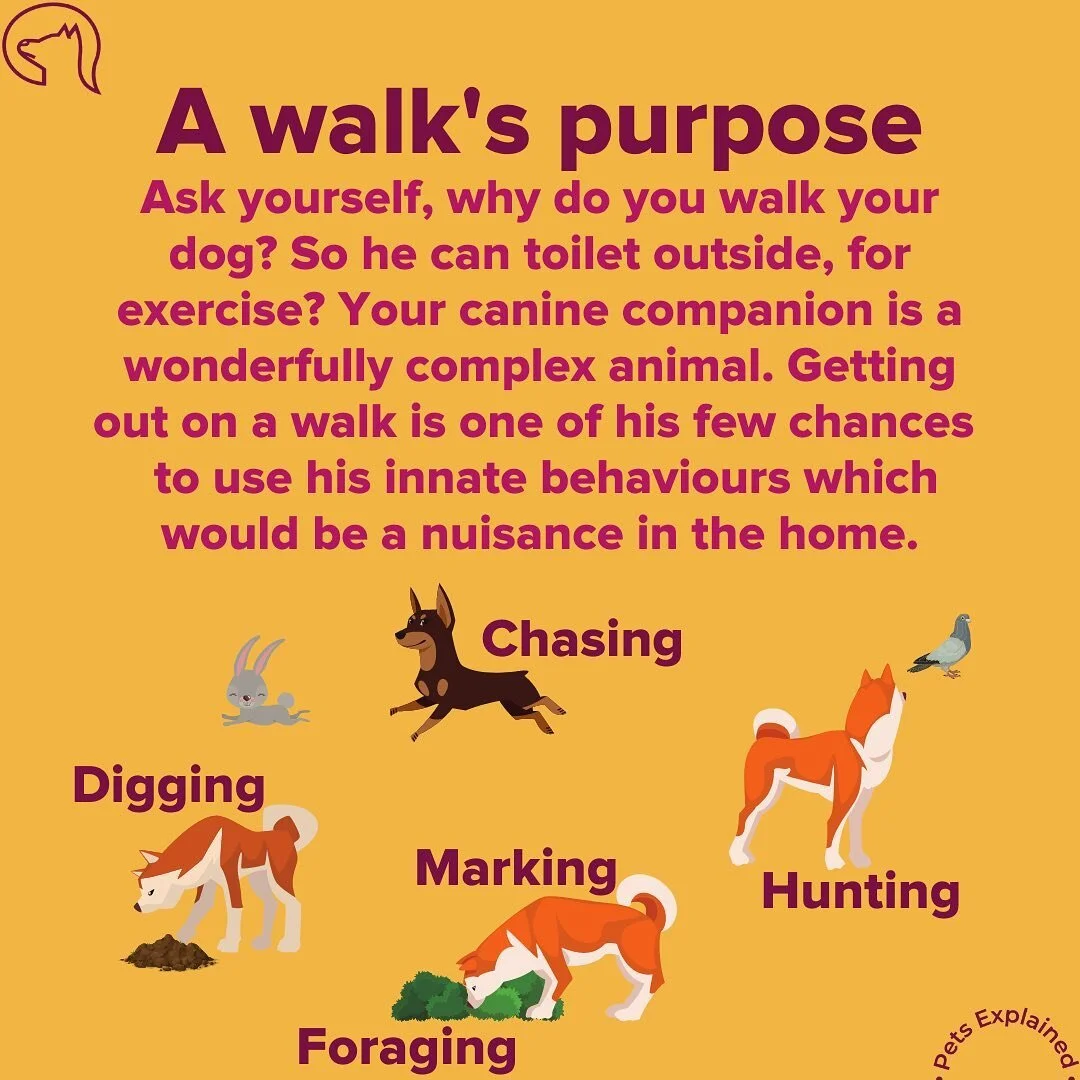

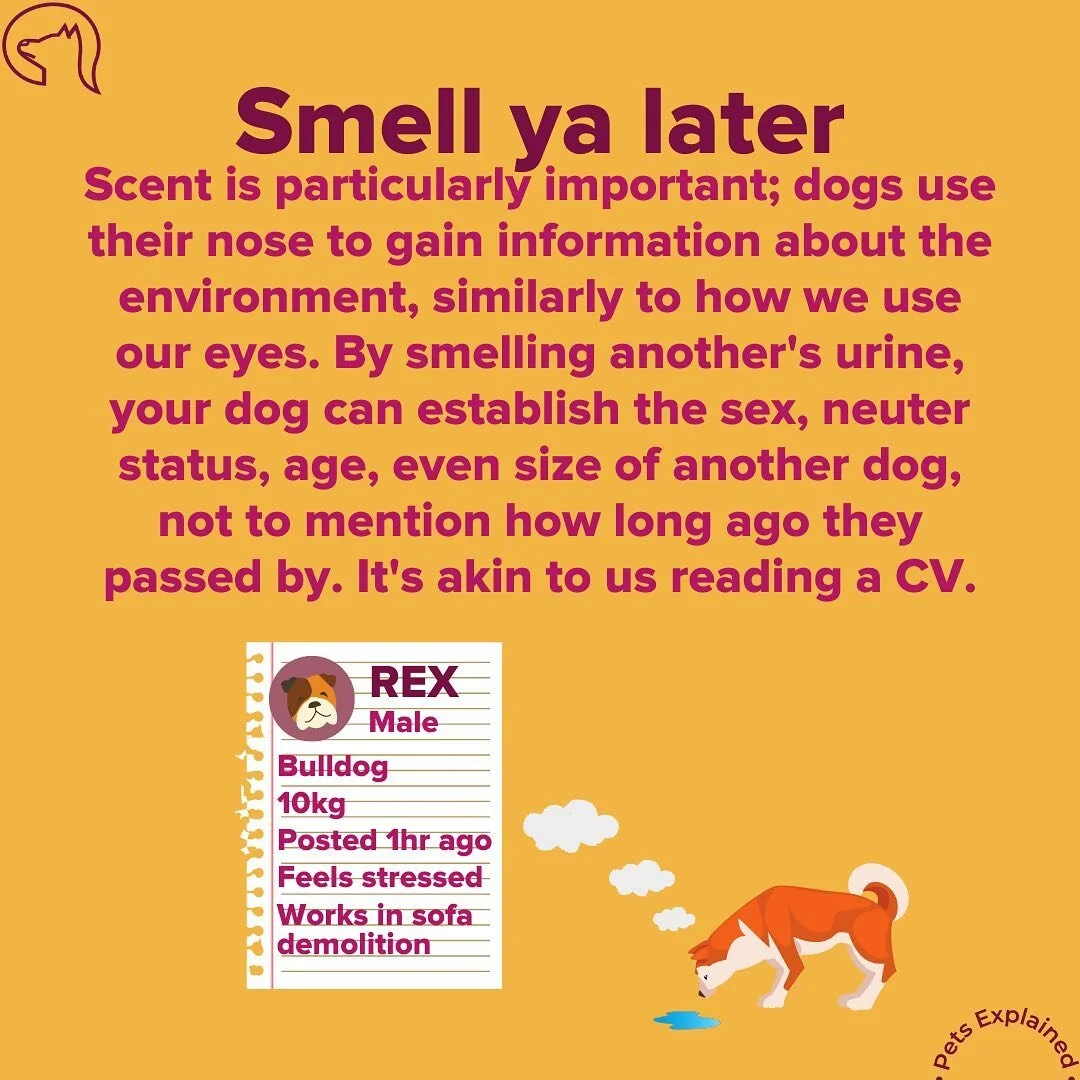


Why should I let my dog sniff/mooch?
While humans are mostly visual creatures, dogs are all about smells. They have millions more olfactory sensors than humans do, and they even have an extra organ, the vomeronasal organ, on the roof of their mouth for the purpose of processing smells. Asking a dog to not sniff during a walk is pretty much the same as asking a person to walk around wearing a blindfold.
A mooching walk where they are able to take in the smells of the world, is the best walk we can offer our dogs as if you really want to tire out your dog, you need to enrich both their body and mind at the same time. Sniffing a particular scent and then interpreting the accompanying information is the canine version of a mental work out. A walk where they’re allowed to sniff until they’re mentally content is the perfect opportunity to address both your dog’s physical and mental needs.
Dogs are dependent on their owners, and along with regular meals and a place to call home, that arrangement comes with a good deal of confinement. Your four-legged family member has almost no control over their life, and that feeling of constantly being constrained can play its toll on their mental health. A daily walk is your chance to give your dog some slack and let them make decisions on their own. If they want to spend five whole minutes sniffing every inch of a fire hydrant, let them. It’s a small decision in the grand scheme of things, but the chance to choose will do a great deal of good for their mental health.
If you spend every step of every walk forcing your dog to heel by your side and making every decision on which way you turn, you could be adding to their stress when you want to be relieving it.
How can I walk my pup while still training lead walking?
Every time our puppy pulls on the leash and gets to where they want to go, we are undoing their lead walking training. While you are still training this, we recommend driving your pup to the park in the car and then use an 8-10m long line attached to a back-clip harness. This allows you to give your puppy freedom, a stimulating walk and good exercise while not undoing your lead walk training.
Here is a video on how to handle Long Lines.
How do I progress from training in my lounge to walking down the street?
As with every exercise we train, we want to begin training in a very low distraction environment, somewhere quiet like your living room.
Our goal in this environment is to have our puppy give us eye contact, walk 10 steps forward (with pup walking with us all the way), stop, and pup stops at the same time and gives us eye contact again. Once they are doing this consistently in the living room, that is when we can progress to a more distracting environment – our backyard!
Once out there however, we cannot expect our puppy to behave the same way as they did in the living room, so we go back to just getting default eye contact. Once they are consistent at this, we can add the first step, then another, and so on. If pup struggles at any point, go back a step.
Once we have got 10 steps in the backyard consistently, we could then move to the front yard, and repeat, then the driveway, then just outside your gate, and finally a quiet park and down the street.
For extra help, check out our Lead Walking unit on our Sit Happens Whānau group [here](https://www.facebook.com/groups/SitHappensNZWhanau/learning_content/?filter=2526780920917520) in these Facebook lives we go through each step and how to progress, as well as some troubleshooting along the way.
My puppy keeps chewing on the lead. How do I prevent this?
The easiest way to overcome this issue, especially when doing the Default Settle Training is by using a [chain lead](https://kiwicanine.co.nz/products/chain-lead). We sell them in our specialist store. Alternatively you could pop a small piece of pvc pipe around the leash on the bottom of it.
The second helper will be to have puppy in a harness, firstly to take pressure off their throat, but also to take the lead out of their direct vision.
However, you also want to check what are the situations your puppy is starting to bite the lead. Is pup maybe getting overstimulated? Or stressed? Are you maybe tugging on the lead? Set them up for success.
It is always helpful to practise at home first to have the pup on a lead. If pup starts playing with the leash drop it and walk away. You can pick it back up again once your pup is calm. Repeat a few times and end on success. Ensure to keep it fun to be on the leash and to follow you, have lots of treats, walk the pup to some things that are nice to sniff, engage with each other, reward good behaviours.
If your puppy is biting the lead because they like carrying something in their mouth, you can provide them with a soft rope tug to carry instead. You could tie a piece of rope or small leash to the toy so you can move it a little to get the pup focused on it instead of the leash and also so you don't have to pick it up all the time if they drop it.
If your puppy bites the lead because they enjoy the tugging motion, you can have 2 leads attached to your pup and drop the one they are biting.
If your pup bites the lead because it always means the fun is over, ensure that the fun isn't over when the lead comes on. Play some games and engage with each other. You could even do some games once home, so pup doesn't get upset on your way home as the walk is over.
What should my puppy’s walks look like?
Puppies are just babies learning about the big wide world and everything in it – remember, everything they are seeing is potentially a completely new experience to them!
Your puppy’s walks should be focused on letting them take in the world at their own pace, and NOT focused on forward movement, exercise, or getting somewhere specific.
They need to learn about the world and process every sight and smell. Some puppies will do this quickly and be relatively relaxed, others will need longer to process and may be more unsure about new things in their environment.
Our main focus should be on our puppies associating all these new things with good feelings and nice experiences – it is great to pair all the new and exciting (and scary!) things with yummy treats to evoke good and positive emotions.
This might mean stopping 50 times in 15 minutes! Allow your puppy to process and start walking again before you move yourself. Be patient with them, they are just babies.
They might like to stop and watch the birds, then the cars and bikes, then have a rest in the shade, then smell an exciting bush! Allow them the time and space to do this. Allow them to sniff each bush and tree and bench and fence for as long as they like, then move along with them when they are done!
If you have a time limit for how long you can be out for, don’t go too far from home or your starting place (e.g. the car). For instance, if you have 20 minutes, allow 10 minutes maximum movement away from the starting point, then start moving back towards it so you don’t have to rush them back home those last few minutes! If they are really young, they may need a rest and a lay down mid walk! This is your puppy asking for time and your patience, they are not ever being “naughty” when they do this. Slow down, and you’ll have much more fun with your puppy. It is amazing watching them learn and explore the world.
My puppy often just sits down and doesn’t want to walk
Usually this is a common problem with puppies feeling overwhelmed. Especially our shyer pups! The big wide world can be very overwhelming for our pups so we need to take it slow with them.
Make sure you are not putting any pressure on the lead, as this will make them put the brakes on even more!
You can do things like walk to the end of your drive, sit down with them, and let them take in the world at their own pace, pairing it with yummy treats so that the big wide world = yummy rewards!
Once they are confident there, drive them to a quiet park and pop them on a long line and do the same. Sit down with them and let them explore the area around you. Once they are feeling confident and are up and moving, you can try to move a bit with them.
If they sit down after walking for a bit, are they tired? Remember it may not be far for us but for their tiny legs, it is a long way! Going for a walk is also very stimulating, and this is tiring too!
Keep walks short, 15-20 minutes once or twice a day while they are still young is plenty. The rule is 5 minutes for each month old your pup is. (3 months = 15 minutes)
Have they lost focus? Get excited! Make them want to come along with you, pat your leg, drop height, point to the ground to interest them in what you are doing and motivate them! After they come forward you can mark it with a “yes!” and reward them.
We do not want to get the treats out and lure them forward as we do not want them to think if they pop their bum on the ground and refuse to move, that the treats will come out.
Most importantly remember that they are like little sponges right now, soaking in the whole wide world - everything is new. If they need time to observe, let them! Find somewhere to sit and watch the world go by. Let pup see people and dogs and traffic in the distance and make sure you are far enough away for them to stay relaxed. We want all those triggers to be non-events: Not too exciting, not overwhelming, definitely not scary.
Nipping/jumping up after beach visit?
The beach seems to be a magic place for most dogs. The sand, smell of the sea and the water and waves themselves paired with all the seaguls, shells and other dogs turn into a quick sensory overload.
Pup gets totally overstimulated. Make sure you keep visits short and what you can try is going to the beach parking lot, where it is a bit more quiet but you can still smell the ocean, put out a blanket and work on a settle with them, maybe after they've already had a relaxing mooch walk in the green. That way pup can get more used to the beach environment. Gradually you can do little mooches at the beach by starting with the feeling of sand on paws and increasing over time to the water, but maximum a couple of days a week.

Any advice for crate training?
Crate training is a brilliant way for us to offer a safe space for our dogs, and a calm space to enjoy a treat or have a relaxing snooze. A great video here by Emily Larlham.
[Crate Training](https://m.youtube.com/watch?feature=youtu.be&v=P8yc5Y9HGY4)
Separation training
Some pups really struggle at first with separation from us. Often this shows up as struggling to settle or whining/barking in the crate or destroying their bed when they are left alone.
In [this video](https://www.youtube.com/watch?v=HWT9DI7hMfo) Emily Larlham shows step by step how to prepare your puppy for being separated and how to increase the distance and time that your pup is alone, while helping them to settle and be calm.
Remember to work at your pup's pace and set them up for success.
Good toys that help settling in the crate
1. **Toppl** - great for using spreads and freezing. Learn about them [here](https://kiwicanine.co.nz/products/westpaw-toppl).
2. **Kong** - great for smearing sticky stuff like wet food or peanut butter or stuffing with food. Learn about them [here](https://kiwicanine.co.nz/products/kong-classic).
3. **Lickimats** - fantastic to promote licking behaviours which are very calming for our dogs. Learn about them [here](https://kiwicanine.co.nz/products/lickimat)
4. **Meaty Chewies** - chewing is calming for our puppies, and giving them something delicious and chewy is a great way to keep them quietly entertained. We recommend natural things like these ones [here](https://kiwicanine.co.nz/collections/chews).
I want to start leaving my pup outside. How do I go about this?
It really is about setting your pup up for success. They won't be ready for the freedom of the house yet when they are still puppies. The soonest we would recommend to give them more freedom is around the age of maturity. With small dogs that's about at the age of 1 year. With really big dogs it can be about 3 years.
That's the time where you can slowly go away from 100% supervision (puppy is either in crate or in puppy proof long term confinement area) and introduce some freedom in the house. Start with one puppy proofed room at a time, for example a laundry, and work up to a lounge/other room. A good idea is to start with short periods, maybe after the dog has been for a walk. If your dog proves trustworthy you can gradually increase the alone times. Some dogs are ready sooner than others, but always go at your dog's pace.
The same goes for starting to keep them outside, if that’s what you want to do. Again, start small, one small puppy proofed area with a “safe spot” such as his crate or a kennel (allow him to get used to the kennel just like you did with his crate) and gradually allow him more space and freedom. Some dogs struggle being outside, but other dogs enjoy it. It will be very specific to how your pup feels. If you do want to start keeping him outside when you are not home, make sure he is happy being outside when you are home, and start with short amounts of time and build it up to longer periods of time as he is comfortable.
Make sure he has plenty of access to shade when he is outside, especially while the days are still so hot. You can rig up a small area of shade cloth if that works for your backyard.
At this stage he is still considered a puppy and they still need lots of rest. Even when our dogs reach maturity, they will still need lots of rest time to be happy fulfilled dogs. For the average dog this is still around 16 hours of rest a day! That is why we need to be sure that our dogs are super happy with resting outside, if we want to leave them outside when we are not home, otherwise this can lead to reduced rest which then leads to a stressed dog.
Teaching my pup to use the dog door.
Start by propping the door wide open and getting your pup comfortable jumping through. You can first use a treat lure, then reward them for going though.
Some pups pick it up super fast but others take a bit of time to gain their confidence.
Once they are popping back and forth happily, drop the door down by a few centimetres (still propped open) so that they just slightly move it upwards when they move through it. Continue this bit by bit making sure your pup is confident always.
Only drop the door down a few centimetres at a time. If your pup seems to go backwards in confidence, back up a few steps and prop the door wider again. The most important thing is it not to rush them, go at their pace. Once your pup is happy pushing the door open themselves you may have to show them that they can achieve this both out of the house and back in again (if it is a swing door that goes both ways).
If your pet door is magnetic, placing tape over the magnets so the door swings easier for the first few weeks will help your progress so that your pup isn’t met with resistance when they try to push the door open. If they are met with resistance, for some dogs it may knock their confidence in using the door. Wait until they are confident going through several times a day for at least a week before re-engaging the magnets.
Please ensure your pup does not use the door to go outside to engage in barking. You can check in on this by using a camera when you are not home, and checking in with neighbours. Continue to check in on this at least once a month throughout the whole first year as barking can develop later.
My dog is mainly outside and super crazy when they are inside or I am outside with them.
This will be because they are so excited to finally have companionship. Our dogs love spending time with us, and it can be lonely for them when they are outside without us.
While some breeds are born to work jobs such as herding livestock with their guardian, companion dogs typically love to sit by you and be engaged in whatever activity you're doing. That's what they have been selectively bred for, so we do need to ensure to satisfy that need.
Usually a good compromise for dogs that are not usually allowed to be in the house is for them to be allowed in but only on their mat or in their crate. That way they can enjoy your presence without causing any of the concerns you might have with having your dog inside.
We want to encourage and teach them to settle in the house. Using the default settle exercise, is a great way to teach this as well as mat training, to teach them to settle on a bed/mat while inside the house.
And of course make use of your crate in your living space to help pup settle around you without needing to be supervised at all times.
Having them around us more in the house will also help, as it won’t be such an overwhelming occasion when they do finally get to be around us.
How much time in the crate is okay?
Puppies can be in the crate for 1 hour per month of age (e.g. 3 months = 3 hours). This is how long they can comfortably hold their bladders for.
If they need to be confined for longer, use their longterm confinement area and give them a spot to toilet. If you are home however, there's no need to give them a toilet spot as you can take them outside.
Dogs should not be left in their crate for longer than 4-6 hours, even if they are adults.
How much time in their long-term confinement is okay? What is the purpose of this area?
The long-term confinement area is used to provide a safe, quiet, puppy proofed area for your pup that they can be in when you cannot watch them, and when they need to rest. It has space for their crate/bed, toys, water, and when you need to go out and leave them alone, a place for them to toilet if they need to.
Puppies need to rest for 18-20 hours a day. This means that over the course of the day, your pup should be resting for the majority of it. The LTC area is perfect for this, especially when you are needing to focus on something else such as cooking. Puppies should be in this area when you are unable to provide them with 100% supervision. This prevents any accidents happening like chewing something they shouldn’t, toileting around the house, etc.
This area is where your puppy should be when you go to work, with their crate open so if they want to snuggle in their bed, they can.
When you are away at work, provide the puppy with an area to toilet such as a puppy pad or grass mat. While you are home, set an alarm on your phone to take puppy out to the toilet at least once every hour, to work on their toilet training.
For more info on how long is okay, please read 'At what age can I start leaving my pup home alone for the day while we are at work?' in our section 'Ethics, Mental Health & Wellbeing".
How long should we use their long-term confinement area for?
It really is about setting your pup up for success. They won't be ready for the freedom of the house yet when they are still puppies. The soonest we would recommend to give them more freedom is around the age of maturity. With small dogs that's about at the age of 1 year. With really big dogs it can be about 3 years. That's the time where you can slowly go away from 100% supervision (puppy is either in crate or in puppy proof long term confinement area) and introduce some freedom in the house. Start with one puppy proofed room at a time, for example a laundry, and work up to a lounge/other room. A good idea is to start with short periods, maybe after the dog has been for a walk. If your dog proves trustworthy you can gradually increase the alone times. Some dogs are ready sooner than others, but always go at your dog's pace.
Our puppy has learnt to climb over the fence of the long-term confinement area
Attach cardboard or something like corrugated plastic to the inside of the fence with cable ties. This way your puppy will not be able to use the rungs like a ladder. Otherwise, you can put something over the top of the area, such as clear hard plastic, and secure it.
During nap times, should I pop my puppy in the crate and close the door?
If you are home during the day and it's puppy nap time, we recommend popping them in the crate and shutting the door, so long as you have ensured that your puppy is comfortable in their crate.
This helps our pups shut off and realise that it is nap time. If we leave them out in their long term confinement area or in the general household area it is common that our pups don’t settle at all or at least not as well and might only snooze rather than getting the proper deep REM sleep they need several times per day! (remember pups need to rest 18-20 hours per day)
We also recommend closing the crate during the night, this will help with toilet training your pup overnight and act the same as during their naps – be a cue for them to sleep!
Additionally it is really good for our pups to learn to rest in their crate in different circumstances, such a useful skill for them to have throughout their whole life.
How can I help my pup be more settled in the crate?
First of all: ensure your puppy sees the crate as a safe space. Have a look further up in this section for more advice on this.
We can then start with having the door closed by sitting with our pup right beside their crate (you can do this while watching a movie etc) and give your pup something super yummy like a dried meat chewie or Lickimat filled with something yummy and whenever they show settling behaviour, you can drop a yummy treat into the crate for them.
We want to make sure puppy isn't scared, thirsty, hungry or needs toiletting, so ensure to meet all those needs before popping pup in the crate. To ensure they feel safe, we stay right with them.
If they are barking/whining excessively, please be in touch with us, explain what's happening and what you have tried and we can give you further advice.
As they start to settle more, we can increase our distance away from them.
How do I train my puppy to go in the car happily?
The utmost important thing for car rides is building a positive foundation for being in the car. Our puppies need good and calm first introductions before we try and ask anything more of them, like going on long trips!
While this might appear to be a long process, if you break it down into little steps (and implement the methods later in this article) it can actually be a relatively quick and easy process. Every dog is different. Some might excel through a few stages without any sign of discomfort before hitting a patch of uneasiness, while other dogs might be the opposite.
If your dog is looking unhappy, unwell or being sick at any stage, you need to take it back a step. They might begin yawning, whining, licking their lips, drooling, shutting down (i.e. curling up and not engaging with anything), or show other signs of general uneasiness. The more attuned you are to your dog and work within their limits, the faster the training will go! If you think your dog may be feeling car sick, have a look at this FAQ we have written on car sickness.
1. Decide where they will most often be in the car, putting their blanket in that spot whenever it’s time for them to go in the car.
2. Start off really small, gradually increasing their exposure to the car and judging where they’re at. Some dogs will be nervous to start, others might be confident. Take the time to assess how they are feeling.
3. A good first step is to simply put them in the car, give them a treat, and remove them from the car. While your dog has undoubtedly been in a car before, really paying attention during this exercise can reveal more subtle cues your dog is giving about their feelings around the car. Is their tail low, and are they looking worried even if they’re not being vocal about it? If so, repeat this exercise until you can see that they are happily expecting something positive to happen when you put them in the car (i.e. tail loosely wagging, wiggly body).
4. When they’re happy in their car position, you can give them one of their Crate Toys there and just hang out with them while they chill out. You don’t need to be paying close attention to them so long as you are checking in that they are happy and comfortable.
When they’re happy chilling out in the car and showing signs that they’ve developed those positive associations with being in the car, you can start doing work around car movement:
1. Turn the car on for a few minutes, then off again. While this might not seem like much to us because we are so used to it, the vibration and noise from a car engine can be intense for a puppy. Make sure they’re unphased with the sounds and feeling of a stationary car before moving forward.
2. Take the short trip down your driveway and back.
3. Next, drive down the road and back.
4. Build up the distance they’re happy with. For some dogs, they might do fine until the drive is more than 15 minutes and you’ll need to slow down. For others, they might finally hit 15 minutes after struggling with the initial stages and be fine from thereon out. Successful training is all about paying attention to the individual.
5. Once you’re able to reach a park or a friend’s place, you can make even more positive associations with the car by making it the means of accessing the things your dog loves, such as people they know and mooching at the park!
Although we want to make the car a happy place, we also want to make it a calm place. This can help set up your walks later on to start in a calm way rather than your dog being over excited as soon as you stop somewhere. To help avoid your dog always expecting something exciting in the car, take them with you when you go on errands and leave them in the car with one of their crate toys, so long as the weather is appropriate (i.e. not on a hot day). By reducing the excitement and expectation, you reduce the risk of them becoming frustrated when you stop or at times where they need to wait in the car.
Remember, the best way to train is to throw in easy wins here and there rather than only increasing the intensity of the task. Randomly add in an earlier stage to mix things up before returning to the step you’re currently at.
Being in the car while it’s moving
• Feed your dog a small amount of food to line the stomach and avoid large meals before driving.
• Secure your dog in their position in the car, whether that is in a crate, held on someone's lap in the back seat (don’t hold a dog in the front seats due to the airbags being a safety risk in the event of a crash), or with a LINK seatbelt attachment clipped to their harness. This helps them keep track of their body position and provides more consistent sensory information, rather than being rocked all over the place.
• Providing view out the front window (rather than the side windows which can be a bit blurry) can help to provide more stable visual information to your dog.
• Have the windows cracked to allow fresh air into the car. This balances out the air pressure while also providing your dog with sensory information regarding their position and movement through the world.
• Provide them with one of their yummy crate toys. This can distract our dogs and help them by giving them something to focus on that is within their control. Chewing and licking also release feel-good and calming chemicals in the brains of our dogs, reinforcing a positive experience for them.
• Avoid sporadic driving (heavy braking, sharp turns etc.). All of us at some point in our lives have felt the stomach-jerking sensation from moving too suddenly and/or too fast. Let’s try to avoid that experience while our dogs are developing!
If your puppy has had a bad experience in the car, take your training right back to square one. We need to start reassociating the car with really good things. If they are really worried just even approaching the car, we can play this game with them, where they only have to just look at the car for something great to happen!
Remember, always go at your puppy’s pace, start at a distance from the car they can handle and watch their body language closely.
Signs that your puppy feels uneasy about it can include avoiding looking at the car, trying to move away from the car or simply refusing to walk towards it, lip licking, tail down and between the legs, bowed head, ears back and down. Your puppy could show just one of these signs, a few, or all of them!
The signs we are looking for that mean our puppy is happy and we can progress are a loose gently wagging tail, wiggly body, ears relaxed in a normal position.
And see here how to utilise a ramp to have your puppy go in the car voluntarily.
Check out this *Must-Watch* video on socialisation!
Watch this video!!
Here are my tips on getting puppy socialisation right!
Socialisation, or being socialised, isn’t about how many dogs or people you’re puppy has met. Nor is it about how many places they’ve been.
It’s founded upon them feeling safe in the world.
Socialisation is often, with the best of intentions, over done by owners.
Moving too quickly can contribute to fears, anxieties, lack of resilience and over arousal in dogs.
☑️ Start off at quiet locations at quiet times.
☑️ Observe your puppy’s body language to decide whether they can cope with a greater stimulus intensity.
Pulling on the lead can be associated with your puppy feeling overwhelmed, as can jumping up at people.
Frantically looking around, refusing to walk, pulling for home or your puppy not taking treats or responding to you are additional clues your puppy walks may need to quieten down for a while.
☑️ Ask people interested in your puppy to wait and give them space.
If they’re compliant and your puppy is relaxed you can always then coach them on how best to interact (calm, avoiding head strokes, no roughing up, tickling or excited voices).
☑️ Avoid walks in darkness until your puppy is confident in daylight.
Only walk during darkness if necessery, most dogs are more vigilant walking at these times.
☑️ Avoid busy roadside walks until your puppy is confident with traffic at a distance, at slow speeds or low frequency- especially if conditions are wet (traffic is noisier).
☑️ Ask people if their dogs are good with puppies. Not all dogs like puppies, and being harshly told off could create fear memories.
☑️ Arrange social walks with calm adult dogs who are good with puppies.
☑️ Give your puppy some quiet walks away from busy locations so they can bumble along calmly and connect with you.
☑️ Give your puppy all the time they need to process information- school runs or hurried walks are not ideal for puppy socialisation!
Fear memories are quick to be made and resistant to extinction- build resilience in your puppy by systematically increasing walk intensity as and when they can cope.
Slow and steady wins the race!
Credit to The Mutty Professor
Risk of Not Socialising due to Vaccination status and how to go about it safely
Socialising your young pup is the most important thing you can do while they are still young. They have a socialisation period that usually closes around 16 weeks of age. During this time it is important to socialise them with as many different people, other animals, places, surfaces, noises, etc.
The risks of your puppy contracting something like parvo is very very slim if you are smart about where you take them. The risk of dogs getting euthanised due to behavioural issues stemming from lack of socialisation is huge.
However, we need to use common sense when taking them into public during this time. If you want to be extra safe and for your peace of mind, you can use a pram, backpack or just carry your pup so that they are not touching the ground. If you want to place your pup on the ground but are worried about doing this, you can bring a fresh blanket from home and place that down before putting your pup on the ground.
In suburbs that are very unlikely to have any stray dogs running around (Sumner, Ferrymead, Halswell, Merivale and other "fancier" neighbourhoods) our team feels safe to place our pups down, and even walking them in the middle of the road where it is less likely another dog has been. Other safer places include a friend’s backyard that's dog-free or has a vaccinated dog, the beach on the wet sand (carry them over the dry sand), supermarket car parks, cafés.
Places to avoid would be anywhere with stray or unvaccinated dogs running around, dog parks, the forests and red zones.
Puppies come with maternally derived antibodies from their mum (if the mother has been vaccinated). This means that for a time, they will be protected by that, but for each individual pup this protection from mum drops off sometime between 2-6 months. If a vaccination is given during the time the antibodies are still working, the vaccination will not be effective. This is why (most) vets have a vaccination protocol where puppies are vaccinated 3 times during 3 and 4 months of age. The final vaccine is often given at 12-16 weeks or later, as this is the timeframe where it's more likely that the antibodies from mum have reduced to the point where the vaccine is effective. This is why we give a “booster” shot at 1 year old, to be safer that our dogs are covered by the vaccination.
Here is another brilliant video done by Emily Larlham on steps for safe and happy socialisation. It is 30 minutes long but well worth the time spent watching. It is really clear and easy to understand, and will give you some constructive and positive ways to move forward with socialising.

Credit to Rescued by Training
The rule of NOT creating a dog that loses their mind when seeing other dogs.
Whilst socialisation is VERY important, it is not actually so much playing with other dogs, but more being able to be around dogs, cars, people, other animals, noises, etc. in a calm and relaxed way. Learning to be focused on the owner when being around dogs and people and therefore being socialised around them is what you are looking for. We call that social environmental experiences where MOST should entail NO direct interaction with the dog/person/'thing you are socialising with', but just being around them.
A well socialised dog can navigate life with minimal stress; high arousal is also stress, so if your puppy is quite confident around dogs, but more so now getting themself a bit worked up, we don't want them to rehearse more of that high arousal behaviour around dogs. Our goal is that the positive value of the owner out-competes the value of other dogs whilst still in no way being worried about other dogs. So, if your puppy still needed to gain confidence around dogs, we would recommend our Puppy Socialisation sessions to gain some positive play experiences. A pup that chooses to engage with their environment or their human while around other dogs is the best and exactly what we are after whilst of course some play is also fine if there are appropriate play mates available, but we would be looking for consistently being able to disengage on cue and being able to focus on owner when around other dogs.
In regards to more actual dog-on-dog experiences:
While puppy play can teach some reciprocal play skills and give puppies great natural exercise, puppies are not always great teachers when it comes to emotional regulation. On the other hand, a good, CALM adult dog will know how to show some more finesse. If you do have access to adult dogs that are good puppy raisers, that is amazing. A session with a good adult dog is, in our estimation, worth its weight in gold and probably more beneficial, at least in terms of behavioural development, than a session playing with other puppies.
But be sure your adult is a "shaper" and not a "corrector". Shapers teach puppies how to earn social interactions which is what you want. Correctors teach puppies how to fear and avoid other dogs, which you do not want your baby puppy to learn. Keep play nice and short and work on focus in between.
Walks with another dog are a great environment for dog socialisation as the dogs often do their own thing, sniffing and exploring while the group keeps moving. If you don't know appropriate adult dogs to let your puppy socialise with, you could consider signing your pup up for small group walks. Read here about what to look out for or pop up a post in our Sit Happens NZ Whānau group} to find a match.
Why does Socialisation of your puppy need to include being able to see dogs from a distance without greeting them?
This is so important as your dog will not be able to meet every dog they see when out and about and learning to move on without getting frustrated or upset is an important skill that we sometimes forget. Some dogs may be on lead, reactive, old, recovering from surgery, or have something else going on that means they just need to walk with their own human and not have other dogs rushing up to see them. This is something we certainly need to respect!
Because of this, our general rule is your puppy only gets to meet one dog out of every 3-5 dogs they see out and about. Suitable playmates they may get to play with, but others they will only get to sniff briefly ('1 Sniff, 2 Sniff, 3, Let's Go'), then move on. The other dogs they do not get to sniff at all.
Let's talk about 'Neutral' vs. 'Social'
Socialisation....one of the most misunderstood words and concepts.
We could consider using a better word to encourage a new way of looking at socialisation....and that word is NEUTRAL.
Neutrality IS socialisation.
Having a neutral dog is a well socialised dog.
Accepting that other dogs exist and your dog can be calm and neutral around them....that is TRUE socialisation.
True socialisation is acclimation to other dogs, environments, surfaces, people etc...and if your dog goes from 0 to 10 when they see another dog, that isn't socialisation, it is the opposite.
If people are constantly allowed to pat and excite your dog....your dog will start to show those same behaviours when they meet others.
Society has twisted the meaning of socialisation into something it should never be...which is play equals socialisation.
Socialisation is NOT play, and that is the main association with this word.
Play is play.
Play will not make your dog more socialised with others...in fact play can have the opposite effect.
We often hear "we socialise heavily at the dog park" or "we encourage our dog to play to socialise" ....the next statement that comes out is "he just goes crazy around others" or "she now sees a dog and barks and barks....I think she is reactive ".
If you heavily "socialise" using only play....you will likely have the opposite of what you may want which is a calm dog around others. You will have a dog that only associates dogs with high energy, over arousal and creatures of high emotions....that is what they will likely show you again and again.
Why would they behave calmly if the main interactions they have involve high excitement and over arousal?
Socialisation should be neutrality.
Socialisation (the true meaning) is being CALM and accepting that other dogs, animals, environments and people exist. That happens with acclimatising and instilling calmness when around other dogs or new environments.
Neutrality means not viewing these things as reasons for over arousal, over excitement and hyper behaviour.
Neutral is a great aim.
Remaining neutral around others can encourage healthy play with others....maybe they will interact, maybe not.
They learn to trust their own judgement and YOURS when neutrality is the goal.
True socialisation IS neutrality.
(Thanks to ABC Dogs, Dunedin for most of the above text.)
Everyone tells me how cute my puppy is. Should they all pet my dog?
People will all find your pup super cute and come over to pet them. Whilst it is good for your pup to be exposed to people, you don't actually want them to interact with too many people. People should be boring, not scary, but also not too exciting. Don't let people overwhelm your pup, don't allow strangers to approach them and touch in your arms unless it is clear that they are happy to make the first move. But even then, most people should just ignore them.
My puppy is afraid of people. Can I have them give my puppy treats to make them more comfortable?
If your puppy is afraid of people we do not recommend they give your puppy treats.
This is because if the puppy is really motivated by what they have in their hand, they may rush forward to take the yummy treat. Once they have taken the food they may find themselves way out of their comfort zone and suddenly far too close to what they are fearful of, and panic which can of course enhance their distrust.
It will put them into a position in which they need to evaluate how much they want the treat and how afraid they are.
We never want to make a dog more aware of their fear by creating unpleasant experiences that will likely make their fear worse.
Instead, allow your pup to choose how close they are to the person, and you give the treats to your pup yourself. We allow the pup to move away if they are overwhelmed and if they choose to look at the person or move towards the person, we will mark with a “yes” and reward with a treat from our own hand.
This allows our puppy to pace themselves, and make decisions and place themselves at a distance they are comfortable with, and creates a positive association with the new person.
This may need to be repeated many times. In time, we want a new person to predict yummy and good things for our pup (e.g. cheese or chicken) instead of being scary!
Have a look [under this link](https://www.sithappens.co.nz/lat-puppy) as well how to address over excitement or fear.
And this graphic shows well what we are going for:
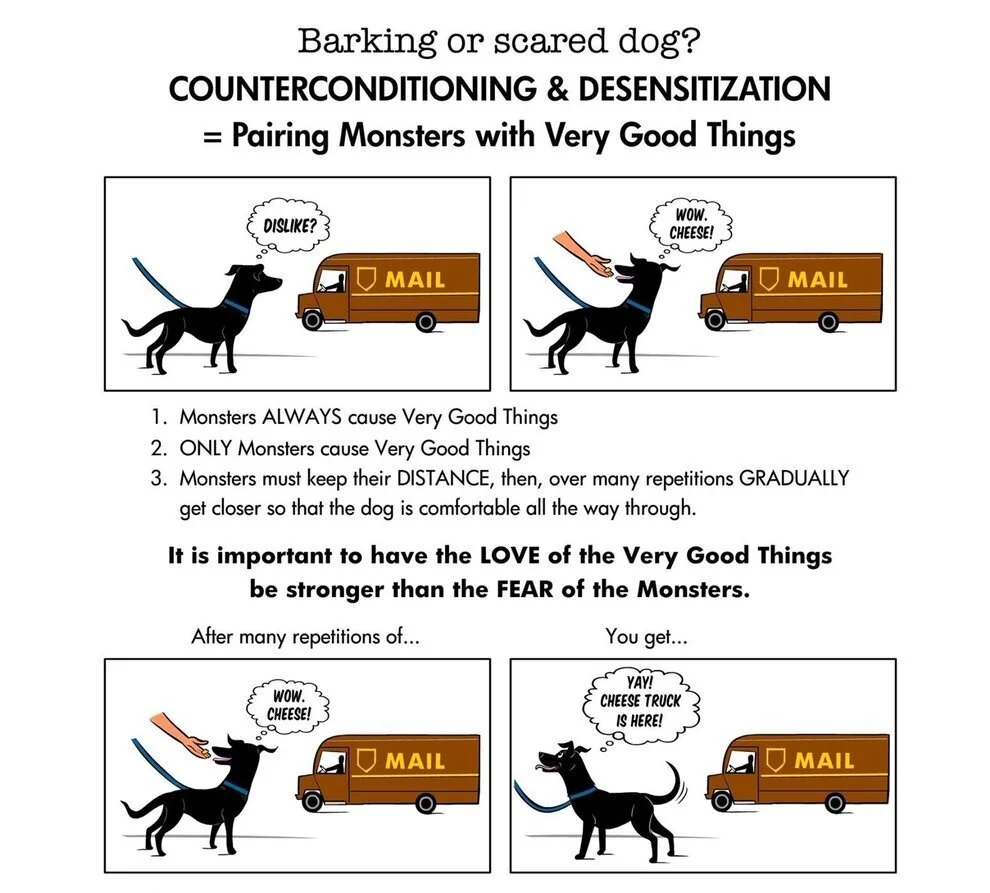 credit Grisha Stewart
Should I take my dog to the dog park?
Even when puppies are fully vaccinated, busy dog parks or busy beaches aren’t always the best place to socialise, as many puppies are overwhelmed by the bigger, boisterous adult dogs.
The advantage of a trip to Bunnings is that the puppies have to be in a trolley which means they can’t be approached by another dog.
Dog parks often have a lot of dogs in it that don't actually want to be there. These are ticking time bombs. And fights happen all the time.
Your dog should only interact with dogs who play appropriately after the [MARS principle](http://sithappens.co.nz/puppy-faq#play).
It is great to go for walks with other social dogs as it's much more natural to keep moving with the whole group rather than constantly tackle each other on one spot.
Dogs need to learn that they can't meet every dog they see which they won't learn in a dog park.
Please watch our team tackle this topic in more detail in one of our Lockdown Talk Happens Series here!
Should I take my dog to daycare?
Read [here](https://www.sithappens.co.nz/does-my-dog-need-daycare/) why we recommend to stay away from daycare.
What does appropriate play between dogs look like?
Click [Here](https://www.sithappens.co.nz/appropriate-play) for infographics and videos on what proper and appropriate play looks like between dogs.
Bear in mind that your main role is being our pup's advocate! This means assessing and monitoring each situation (body language, vocalisations, intensity of play, etc.) as it comes up and removing yourself and your pup if either of you start to feel unsure or unsafe, get overwhelmed, or if the play gets too intense. Distance is your best friend.
While a little play with well suited playmates is good (IF your dog is keen on playing with others), dogs do not need to have extended play time with other dogs in order to be “socialising” with them. Being able to focus on you and respond to cues and be calm in the presence of other dogs is much more important! Just chilling out with other dogs is more important than our dogs having a wrestle with each other.
Should I let my puppy meet other dogs while on leash?
Even dogs that have previously met and liked each other may react snarly when meeting on a short leash. Reserve dog-to-dog interactions for settings in which they can act freely without restraint: Click [Here](https://static1.squarespace.com/static/58a53a2315d5db450ad7e320/t/5b8762ab4d7a9cdc9afac6b8/1535599298418/On-Leash+Meetings) for more info.
Usually when a dog is out and about on a lead, there is a reason for it. Either they are in training, or young, or sick or reactive, or their owner just wants time with their dog and not be bothered. Our general rule is that we never let our dogs meet other dogs on a short lead. Why is this?
When 2 leashed dogs move towards each other that usually means that they are pulling on their own lead, which we don’t want to reinforce. We want our dogs to learn to be calm on the lead, and to know that they can’t always meet every single dog they see. When they are calm on the lead, that’s when we might take the lead off and say ‘okay, go play’. (If it’s the right time and place for it).
When our dog is pulling towards another dog, they are leaning forward which is getting into quite a threatening position. So the approach towards the other dog is already wrong because they will then be meeting nose to nose instead of nose to bum. This makes them naturally more on edge and aroused. At the same time, they don’t have a flight option so they know they can’t get away. Without a flight option they are left with three reactions - freeze, fight or flirt and without the flight option they are more likely to fight.
If they are playing while on a lead they are more likely to get tangled up and hurt themselves, which could lead to them creating negative associations with being on the lead, or with other dogs.
If there is no other option when out on a walk (e.g. passing another dog on a narrow path) and the dogs will meet, keep your meetings short: 1 Sniff, 2 Sniff, 3 and go: Click here for an infographic on this.
Does my dog love other dogs?
Just like humans, dogs have different levels of tolerance towards other dogs. Not all dogs want to play with other dogs, and that's okay! Some dogs prefer human company. We want to observe our dog's body language when they are around other dogs to get an idea of how they are feeling around the other dog(s).
Some dogs might have one special dog friend they love to play with, but when faced with multiple dogs they don't know, can get very overwhelmed! Click [here](https://www.sithappens.co.nz/does-my-dog-love-other-dogs) to find out more.
Info on desexing (Neutering/Spaying Your Dog)
[Here](https://www.sithappens.co.nz/desexing) is a link to information going through various things relating to desexing including the benefits of desexing and when the best time to desex your dog is.
How do I switch my puppy over from one type of food to another?
If you are switching from brand of biscuit to another, the swap should be done gradually over 1 week to prevent a tummy upset.
Start by calculating the daily amount of food required for your pup's age and weight. This will be located on the side of the bag of food under "Feeding Guide"
**Days 1-2:** Give 3/4 of their daily food amount as the food they are currently used to, and mix with 1/4 of the new food. Do this for 2 days.
**Days 3-4:** Give 1/2 of their daily required amount as 1/2 of their current food, and 1/2 as their new food (mix together and split over the day).
**Days 5-6:** Give 3/4 of their daily required amount as their new food, and 1/4 as their current food.
**Day 7:** Give 100% of their required daily amount as their new food.
If you are switching from a biscuit to raw food you can immediately switch to raw food 100% (e.g. that night feed their last amount of biscuits and the following morning feed their first meal of raw) but this should be done with only one protein source to begin with. We recommend contacting nutritionist Julie Best for information on how and when to begin introducing more protein sources to your dog's diet and how to ensure it's balanced.
How many times per day should I feed my puppy?
Puppies should always be provided with their daily amount of food split into 3 meals per day until they are 16 weeks old. This is because puppies can only hold so much in their little tummies!
When you want to reduce to 2 meals per day at 16 weeks, start by reducing the lunch amount by approximately 20 grams of food per day (while increasing their other two meals to make up the full amount) until after a week or so they are only getting a meaty chew or snack for their midday meal, and their full daily amount split into 2 meals.
Dogs should always be fed 2 meals per day (breakfast and dinner) no matter how old they are! This will keep their tummies happy and reduce the risk of vomiting after eating due to ingesting too much at once.
What do we feed our own cats and dogs at Sit Happens?
Every dog will be unique in what type of diet suits them best.
At Sit Happens we like to feed our pets a balanced raw diet.
Check out [this](https://kiwicanine.co.nz/products/raws-4-paws) awesome CHCH-based delivery service with a qualified nutritional advisor putting together your pup's diet.
How much can my puppy exercise?
Puppy exercise needs can vary greatly depending on breed, age, and individual temperament. While some traditional advice suggests limiting exercise to "five minutes per month of age," recent evidence challenges this guideline.
Here's a more nuanced approach:
Age and Activity: Puppies benefit from regular play and socialisation. Short bursts of activity (e.g., playtime with other dogs) are usually good, and most puppies can handle more than the restrictive guideline suggests.
Controlled Exercise: Instead of strict limits, focus on balanced activity. Puppies should have opportunities for both play and rest. Activities like short walks, play sessions, and training can help develop muscle and coordination without overstraining their joints.
Avoiding Overexertion: While puppies are energetic, watch for signs of fatigue. If your puppy seems tired, it's important to let them rest.
Fit and Lean: Keeping puppies at a healthy weight is crucial. Excess weight can strain developing joints more than exercise itself.
Veterinary Guidance: Always consult with your veterinarian for tailored advice based on your puppy's specific needs, especially if you have a breed prone to joint issues.
In summary, rather than adhering to strict limits, allow puppies to engage in safe, age-appropriate activities that promote their physical and mental health while being attentive to their energy levels and needs.
Please read [here on page 34](https://indd.adobe.com/view/1aad4f26-c7c5-4895-a216-889447348bf2?fbclid=IwY2xjawFfMHlleHRuA2FlbQIxMAABHfLSZ_MWSfCiMKuBm6GHfR6iVqKlOaym-cv_y_-vV9sx2rhGyXKD8fAb6w_aem_pBaChkXMDMsJiT9KkvEBDQ) a full article on this.
Please read [here](https://www.mylamedog.com/post/what-is-the-logic-behind-not-exercising-puppies-until-the-growth-plates-are-closed) for further info. In summary, the most important thing is that puppies should be free of hip and elbow dysplasia, and genetic tendencies to conditions such as osteochondritis dissecans. The most important environmental issue is to keep puppies thin and not let them get overweight. High impact exercise (such as jumping from heights or sharp turns) should be avoided until maturity and a period of adequate conditioning, agility and strength training. There is no evidence that normal exercise causes damage to growth plates of puppies. In fact, jogging exercise (such as on a treadmill) appears to be beneficial to normal joints. It takes a lot of exercise to cause damage to joint cartilage. Jogging an hour per day seems to be beneficial to joint cartilage. But high speed running for long distances (12-24 miles per day) may eventually result in deleterious changes to cartilage. Dogs are built to run. Further, normal puppy play helps them to develop muscle, ligament, tendon, bone, and cartilage strength as well as coordination and proprioception.
Should I feed my dog rawhide bones?
No, they are very bad for your dog. This is how they are being produced:
1. Separate the layers of the leather.
2. Bleach leather and chemically preserve.
3. Enhance leather with colouring.
4. Cut, roll, glue and press into shapes.
Use natural chewies instead, like Venison tendons, sheep ears, etc.
What should I do if my puppy gets car sick?
As you’ve probably already figured out, dog motion sickness is real, and it can make even the shortest trips stressful for you and your pooch. Fortunately, there are things you can do to quell your pup’s nausea, from conditioning your dog to car rides to using dog motion sickness medications.
**What Causes Dog Motion Sickness?**
Dog motion sickness is more commonly seen in puppies and young dogs than in older dogs, just as carsickness afflicts more children than adults. The reason for this is because the ear structures used for balance aren’t fully developed in puppies. This isn’t to say that all dogs will outgrow travel sickness, though many will.
If the first few car rides of your dog’s life left him nauseated, he may have been conditioned to equate travel with vomiting, even after his ears have fully matured. Stress can also add to travel sickness, so if your dog has only ever ridden in the car to go to the vet, he may literally worry himself sick on the road.
**Signs of Dog Motion Sickness**
Dogs don’t turn the unflattering shade of green that people do when they’re experiencing motion sickness, but there are some signs of dog travel sickness you can learn to identify. These include:
- Inactivity, listlessness or uneasiness
- Yawning
- Whining
- Excessive drooling
- Vomiting
- Smacking or licking lips
**Treatment for Dog Motion Sickness**
The best way to prevent dog travel sickness is to make the car ride as comfortable as possible for your dog.
Your dog will experience fewer nauseating visual cues if he faces forward while you’re traveling, rather than looking out the side windows. One way to guarantee this is by using a dog seat belt attached to the dog's harness and keeping the dog in the middle of the backseat. If you choose to have your dog ride on the front passenger seat, keep in mind that air bags do pose a potential hazard to dogs. Even though you can’t be sure your dog will face forward while riding in a travel crate, many people prefer to use crates for safety -- and they do have the added benefit of containing vomit, should your dog become ill.
Another thing that may help your dog’s motion sickness is to lower your car windows a couple of inches while the car is moving. This helps balance the air pressure inside the car with the air pressure outside, which may help reduce your dog’s nausea and discomfort. Also, be sure to keep the car cool and well ventilated, as a hot or stuffy vehicle can contribute to unpleasant sensations for your dog.
One trick you can try to prevent dog motion sickness is to limit your dog’s food consumption prior to travel. Then, right before the trip, give your dog a small piece of sugary candy, which seems to reduce sensations of nausea. Never give your dog chocolate candy or treats made with xylitol, however, because these are toxic to dogs.
If your dog has learned to associate riding in the car with feeling stressed and nauseated, there are a variety of conditioning techniques you can try to lessen this connection. These include:
- Taking a break from car trips for a week or two
- Changing vehicles to avoid association with past unpleasant experiences
- Taking short car trips to places your dog enjoys, like the park
- Gradually building your dog’s tolerance to car trips; start by getting your dog used to approaching the car, then spend some time in the car with the engine off. When your dog is ready, take short trips (around the block, for example) to build tolerance before progressing to longer car rides.
- Using treats to make the car a fun place for your dog (but be careful you don’t give too many and make your dog nauseated)
- Buying special toys that your dog enjoys and only has access to in the car
**Dog Motion Sickness Medications**
Dogs that don’t outgrow motion sickness and don’t respond to conditioning may benefit from the use of medication. There are a variety medications from all natural ones to more serious onces that may decrease your dog’s motion sickness symptoms.
Be sure to consult with your veterinarian before purchasing any. You will need to know the correct dose to give and they can consult you what medication to use.
More on the topic here.
What are good options for treats for training sessions?
It is up to our dogs to decide if something is an actual reward or not! So, you have to know your dog and see if they’re working "enthusiastically" or not. If they’re distracted, sniffing around, taking the treat without really paying attention to you and going back to their business it means that the value of the treat is not high enough.
**What are good options? ** Cooked chicken, other meaty yummy stuff. Freeze Dried Venison Heart, Air Dried Ziwi Peak and all things pure or high in meat. Treats should be cut/broken up into pea sized pieces.
**What aren't good options? ** Highly processed supermarket treats, massive treats that can’t be broken up.
What are some good long lasting chewies?
We always reccommend using natural chewies for our pups. They last a long time, are tasty for our pups and they are healthy! We use things like Venison Tendons/Chews/Paddywacks, Chicken Breast or Lamb Chews or Trachea. Anything that is meaty and natural will be a hit with your pup!
Find chews [here](https://kiwicanine.co.nz/collections/chews).
Please always make sure to give these in moderation (for young pups one chewy per day is plenty). Quite often while they are still young they won't always completely finish their chewy in one sitting, so you can give it back to them later on that day if you want to!
Please don't give your pup anything made out of rawhide. They are unhealthy and can be a serious health risk if too much is swallowed at once, as due to the synthetic nature of the processing to make these treats, they do not digest well and can cause an obstruction that needs surgery to be fixed.
My puppy eats poop!
What are some of the reasons dogs and puppies eat poop?
- It is a natural behaviour for puppies to engage in (this includes eating their own and other animals poop), however they will usually grow out of this if we help them not to practise the behaviour.
It’s in their DNA! This innate drive dates back to when they would live in family packs together to protect each other from parasites around the family living area. - Veterinarians consider eating poop to be a normal dog behaviour in a healthy dog however lack of proper nutrition, some health conditions, parasites or certain medications can exacerbate the problem.
- It is a normal and natural behaviour at certain life stages of a dog – mother dogs lick their puppies to stimulate elimination and then clean up their poop to keep the nest area clean by eating it in the first 3 weeks of a pup’s life.
- Apparently female dogs are more likely to eat poop – the above reason could be why.
- Greedy dogs who like to steal food or eat extremely quickly are also more likely to eat poop
Environmental or behavioural stress can also cause poop eating behaviour. For example:
- isolation and being kept in an extremely small space for long periods of time
- anxiety (particularly if they have had harsh methods used or been punished when potty training)
- attention seeking – most people will react when they see their pup eat poop!
- inappropriate association with real food (usually encouraged by smell)
What can I do about it?
- If this is a new behaviour, make sure to discuss with your vet and get your pup a vet check to rule out any medical or nutrition issues that could be causing the behaviour.
- Always feed your puppy in a clean area away from where they defecate.
- Keep your puppy’s area and backyard as clean as possible so there isn’t any poop to consume.
Training:
- Take your pup out to the toilet on a leash while you get the behaviour under control, and take some high value treats (chicken, cheese, etc.) with you and as soon as your pup has finished toileting, bring the treat into their line of sight and toss it slightly away from your pup so they run to pick it up, continue to do this until they are far enough away from their poop. The leash will prevent them from going back to get it. Put pup back inside before you clean up their poop. Be consistent in this every time they toilet and it will teach your pup to run to you for a yummy treat instead of going back to eat the poop.
- Work hard on your friendly “leave it” and recall (such as “touch”) cues.
Puppy teething
Puppies generally start teething between 4 and 6 months old. During this time, you might find teeny baby teeth around the house or see a little bit of blood on toys they have been playing with. This is totally normal. As long as it is not a large amount of blood there is no need to worry. During this time our puppies may start wanting to chew more to try and soothe their mouth or be a bit less tolerant of things (perhaps a bit moody or grumpy) because teething can be sore!
During this period (and always) make sure your puppy has lots of suitable things to chew. Some puppies might like harder things but when their gums are sore, they may start favouring softer materials.
A great trick is plaiting a towel or some type of soft fabric, dunking it in water (or broth) and placing it in the freezer and giving it to your puppy once it is nice and cold! This is really soothing for their sore gums. There are also some types of puppy toys made for this purpose.
If your puppy is searching for things to chew, ensure your management is up to scratch. Make sure you are picking things up off the ground they can’t have and utilise your puppy proofed long term confinement area/pen to ensure your pup isn’t getting a hold of things they shouldn’t.
Teaching your dog to be bathed – force free!
Things you’ll need:
· High value treats your dog loves
· A non-slip mat suitable for your bath or shower
· Dog specific shampoo
· Towels
· A licki mat that can hang on or stick to the wall (the Lickimat Splash version is just for this) or a suitable spot on the shower or bath wall that something sticky they enjoy like peanut butter can be spread on
Teach your dog to love baths before you HAVE to wash them!
We all know dogs; they love stinky and disgusting things and if they can roll in it – even better! Be sure to start training your dog to be okay with water, the bathroom, and washing before it's necessary to wash them when they get into something dirty. If they have never been exposed to it before this happens, it can be a very scary experience for them that they won’t want to participate in again anytime soon. Do yourself and your pup a favour by doing a little training now!
Teach your dog that the bathroom and the area (shower or bath) they get washed in, is a great place!
Start by letting them explore in there. Pick up anything you don’t want them to have access to and give them something like a food toy they can play with so that the good associations with the area start early. Once they are comfortable in there, teach them to jump or step into the washing area by themselves if possible, with encouragement and rewards from you every step of the way. By being able to get themselves in and out without you having to pick them up gives them confidence and autonomy. We can accidentally overwhelm our dogs by picking them up and putting them in the middle of an area or situation they aren’t comfortable with. For smaller dogs, a step or ramp could be helpful if you are using a bath. If you must pick up your dog, ensure they are comfortable being picked up/helped up in other areas of their life – and be aware that some dogs never get used to being picked up.
Ensure you have a non-slip surface for your dog to stand/sit on in the washing area
This is an absolute essential item. If you have non-slip matte tiles, these are okay for your dog to stand on, however, if you have any type of smooth surface in the washing area please make an effort to give them a non-slip surface. A common, cheap, and easy to get surface is a rubber mat with suction cups on the bottom to ensure it doesn’t move around once it gets wet. These are found at most hardware stores!
If your dog feels like they are going to slip, it will make them feel very worried and unsafe which can lead to them fearing being washed. Even if you don’t use a non-slip mat and you are fine, please remember our dog’s paws are very different to our feet!
Licki mats – your best friend!!!
Have something like a licki mat that you can hang on or stick to the shower/bath wall, and smear something SUPER DUPER tasty on it. If you don’t have a licki mat or can’t find it, simply smearing something sticky like peanut butter on the shower or bath wall will do in a pinch! You can simply wash it off later. Licki mats have the added benefit of being able to be frozen, so will last longer if you are doing a full body wash.
Why use one?
First, it pairs washing with something our dog enjoys eating which can help them make good associations with bath time. Second, it keeps our dog still and in one place while we get on with the washing! You can’t, and shouldn’t, hold a slippery and soapy dog in one place!
Adding the water
Once your dog is happily interacting with the space, we can slowly begin to introduce water. Start by turning the tap on a low volume, directing it away from the dog. Ensure the water is a comfortable temperature – lukewarm is perfect. Please do not wash your dog in cold water! Allow the water to fill one end of the space, so that your dog can choose to interact with it. When they do, reward them well with your high value treats that you have on hand. Make sure they are totally happy immersing their paws in a very shallow pool of water before you move onto the next step.
Gradually increase the amount of water and the intensity of the flow of water. Slowly move up their legs and onto their body. This may take at least a few sessions to achieve. Slow and steady wins the race!
Why do I need a dog specific shampoo?
Human shampoos are not made for dogs and can lead to an increase in itchiness, dry skin, and dandruff. We recommend the dog range from Ethique. Their ingredients are simple, soothing and smell amazing – you can even get a conditioner if you want your pup’s fur feeling extra silky! They come in bar form so you aren’t accidentally wasting a whole lot of liquid soap, and they come in a cardboard box – no plastic! Far better for the environment!
Don’t forget the drying!
Remember, drying your pup is part of the process they will need to be comfortable with! It can be a very strange and over stimulating experience for some dogs. As with the water, start slow and go gently at your pup's pace. Most dogs are not keen on being “ruffed up” with a towel. Use gentle motions in the direction of your dog’s natural coat direction.
If you would like your pup to get used to being blow dried, this will be another step entirely. Approach it exactly the same way you did as adding the water, slowly and step by step. If you are using a human hair dryer only ever use it on the coolest setting – the higher settings are far too hot for our pups and may hurt them. Remember that we are directing at it straight at their skin. If you are interested there are dog specific dryers you can buy.
Remember: If at any point your dog shows discomfort or stress with washing, go back a few steps and make sure they are comfortable before proceeding. A few 5 minute sessions are far better than a massive training session all at once.
Happy washing!
Why does Sit Happens require puppies to wear a harness in class?
In short: So that they don't choke and harm themselves when they pull towards something exciting. See a video [Here](https://www.facebook.com/740372192/posts/10159636835152193/?d=n) to learn what's inside the dog's neck and why you shouldn't attach a leash to it to prevent serious neck injuries and health problems.
Using a harness while training loose-leash skills mitigates the fallouts that come with training on a collar.
We don't believe flat collars are inherently bad - they're just no good for early training, and carry substantial health risks relating to the cervical vertebrae, thyroid, and nervous system.
At this early stage especially, we are really wanting to use a harness as the attachment point for the lead. Absolutely still have their collar on additionally if that's what you wish to do. We recommend a comfortable harness that allows the dogs' muscles and joints to move in natural ways (i.e. non-restricting).
[Here](https://www.whole-dog-journal.com/care/collars-harnesses-leashes-muzzles/can-a-collar-damage-a-dogs-thyroid/) is a very short summary of some of the available research and discussions. If you do choose to go with a harness to last, we import and stock our favourite - the [Perfect Fit harness](https://kiwicanine.co.nz/pages/perfect-fit) for which we offer a [Swap Deal](https://www.sithappens.co.nz/harness-swap) as well. However, even something cheap and temporary would do - just look for the Y-Shaped harnesses to allow for healthy shoulder movement, and avoid anything that intentionally squeezes your pup if they accidentally pull.
What should I do if my puppy is scared of its harness?
Watch [here](https://www.youtube.com/watch?v=k7edMjwEY1c) how to desensitise your puppy to their harness.
And [here](https://m.youtube.com/watch?v=H1kuBjHuN-w&fbclid=IwAR0BgEOj6ynQFWAtro0y3HplFm7ifK4zF3a-rCtNvW_Wdtotz6xPLB8GoUc) is specific advice for harnesses that have to go over the head.
Some of the most important things while harness training are:
1) Take it slowly
2) Never push the harness toward your dog, always allow them to choose to move towards it
3) Make it fun!
4) Keep sessions short and regular (you can do this a few times per day!)
Make sure you are not forcing the harness on your dog for walks while training a good association with it, as this will undo all the progress you have made! When you HAVE to put the harness on, you could pop the dog on the table or in the car with a snuffle mat and a bunch of treat crumbs to put the harness on in the meantime. Do be sure to create a different setup, so you can pick your training up where you left it off.
Harness Swap Deal
We sell the Perfect Fit Harnesses, and offer a swap deal that allows for the harness to grow with your puppy. Click [here](https://www.sithappens.co.nz/harness-swap) for details.
Collar
We use collars on our dogs primarily for keeping their registration tag and our contact phone number(s) on our dog, should our dog ever go missing. This ensures that whoever might find your dog has a quick and easy way to contact you!
For safety reasons, we use the registration tag "strips" instead of the "disc" and slip it over the thick part of their collar. This means that the dog is unlikely to run the risk of it getting caught in anything and as a bonus it does not jingle and make noise when they move (which is annoying for both the dog and the humans around them!).
Long lines
Ideal for recall training and mooch-walks. These are a fantastic happy-medium between a short leash walk and our dogs being off leash. These give us the opportunity to allow our dogs more freedom and training opportunities than they have on a short leash, without being off leash.
We use a length of 5-10m for our [long lines](https://kiwicanine.co.nz/products/long-line) and always use attached to a **backclip-harness**.
A must-have for any dog owner!
Learn about Long Lines in details [here](https://kiwicanine.co.nz/blogs/choosing-right/long-lines).
Treat Pouch
Ideal for easy access to rewards when training or out on walks!
Best to use a [treat pouch](https://kiwicanine.co.nz/products/treat-pouch) which can also hold your keys and poo bags while keeping your pockets clean from dog treats and keeping your hands free!
Lead slips
Does your dog need some space? With their high visibility, [lead slips](https://kiwicanine.co.nz/products/lead-slips) are the perfect way to communicate to others what your dog needs without you having to say a word!
These lead slips have a velcro on the inside to ensure they sit on the lead where you like them. The white letters are more visible in the dark.
We can order any colour and wording, the only restriction is your imagination! Most common is IGNORE.
Tug toys
You'd be hard pressed to find a game more fun than an exciting game of tug! Playing with our dogs is a bonding miracle. They love having fun with their favourite humans.
Most dogs find a toy more rewarding than treats and are much more responsive out and about if the reward is a game of tug for instance. Tug toys are ideal for doing this!
Our favourites are made out of soft but durable material that won't hurt our dog's mouths, like the [Puller](https://kiwicanine.co.nz/products/puller) or the [Leather Tug](https://kiwicanine.co.nz/products/julius-k9-leather-tug) or the [Puppy Tugs](https://kiwicanine.co.nz/products/puppy-tug-set).
Seatbelt Attachments
Your dog's safety while travelling in the car is imperative. This can be done by using a crate or a [seatbelt attachment](https://kiwicanine.co.nz/products/seatbelt-attachment) connected to a backclip harness.
This will keep them more secured in an accident and will keep them still and in one place to make sure they are not bouncing around the car and being distracting and a potential hazard while you are driving.
What can I do if my puppy hates their collar/leash?
We want our puppies to associate the collar and leash with good things! At first this will be a very weird feeling for your pup if they have not worn one before. We can put some steps in place to ensure your puppy has a nice time while wearing them!
Put the collar/leash on before feeding, before a play session and other fun things happening! This is so they realise that good things happen while the collar is on.
Something else really important is to resist putting pressure on the collar and leash, especially when they are first getting used to them, as this can be a very uncomfortable feeling for them.
As they get more comfortable with the collar, you can start to leave it on for longer periods at a time.