Fun and Focus Level 2 - Week 2
We are using a free-shaping technique to teach our dogs to enjoy going on their mat. In this video, Susan Garrett is showing the exercise, naming the mat the target or Hot Zone. She names it Hot Zone because she uses it as the spot where all the good stuff happens. Please be aware that she uses the word “search” to release the dog, but we just use the release cue “Okay”.
Once our dogs are going out of their way to find the mat, we start expecting a sit on the mat. Once that is going well we can start expecting a down. Once our dogs run to the mat and lay down on it whenever we put it down anywhere we can start increasing the time before we release them with the ‘Okay’.
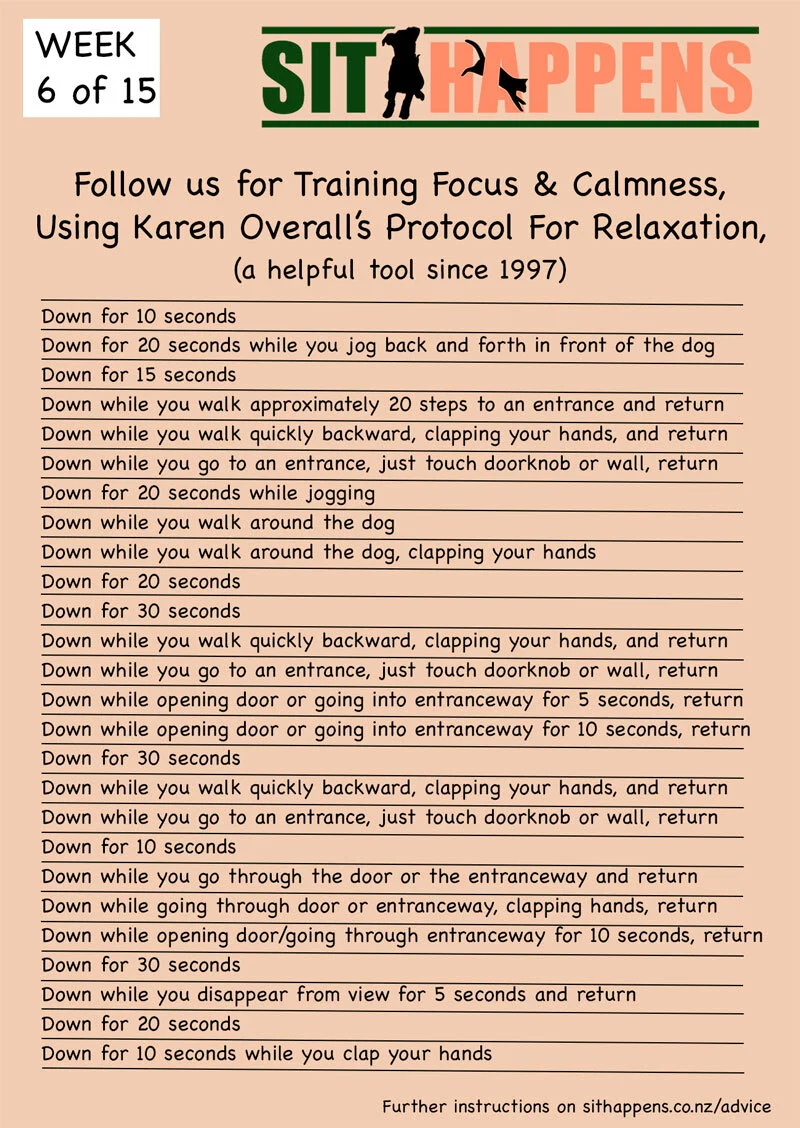
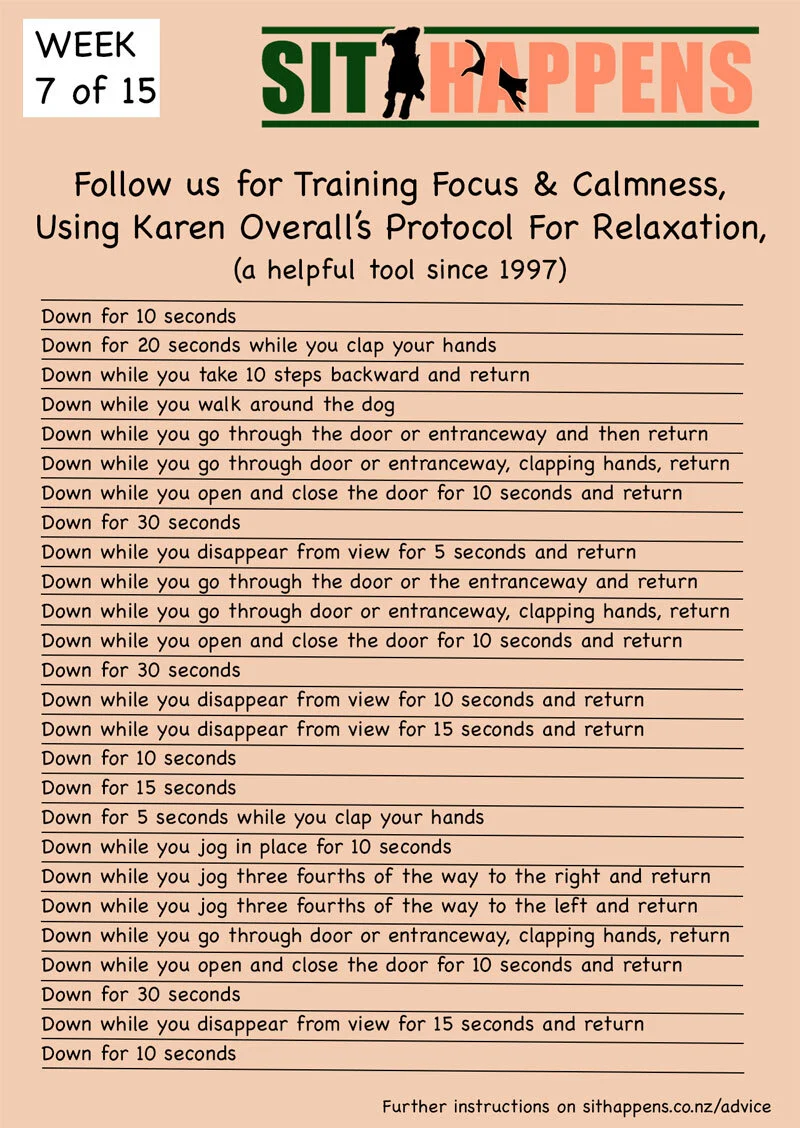
Start working your Karen Overall Protocols of Relaxation with your dog in a Down on the mat.
Between starting the target training and having it on a cue, we do not want to have the mat laying around because our dogs should always get rewarded when they choose to go there, but we are not always ready and watching.
We will add the cue in a couple of weeks.
Advanced Lead Walking Exercise
Train Loose Lead Walking With Scent Rewards
50 Recalls
Complete another 50 recalls without a single failure (reset back to zero every time your dog doesn’t come).
THE THREE PILLARS OF A RECALL FOUNDATION
What Are The Three Pillars?
In order to train a top quality recall, we first need a solid foundation that will set us up for success. The three pillars of this foundation are MANAGEMENT, SATIATION and RELATIONSHIP.
Pillar 1: Management
Management is all about forward thinking. A crucial part of early recall training is systematically reducing your dog’s chance of failure by managing their environment. As much as possible, we want to prevent them from being in a situation where they are ignoring a cue to recall. Every time you call your dog to come and they ignore you, you’re setting your recall training back by a huge chunk.
Here are some management strategies for preventing failed recalls:
Use a long leash so that you can prevent your dog from getting to the rewards if you need to
Only let them off leash in places where you won’t need them to come (e.g. your backyard, an empty dog park etc.)
Get in the habit of going to get them rather than trying to call them if you’re not sure if they’ll come
“Test the waters” in a situation you’re not sure they’ll recall in by seeing if they respond to an informal cue like a whistle or speaking to them
For the first month of recall training, never call your dog to come unless they’re looking at you
Pillar 2: Satiation
In canine behavioural science, satiation is when a dog has had their fill of a particular reward, and therefore it is less reinforcing. For example, a dog that has just eaten an entire bag of kibble is likely to have their desire for food satiated, and is much less likely to find food reinforcing. An exhausted dog that has been chasing birds for four hours is less likely to find chasing birds reinforcing.
Simply put, the more your dog’s need for a particular reinforcer has been satisfied, the less of a priority that reinforcer becomes, unless we are looking at unhealthy obsessive behaviours, such as Collies chasing a ball.
The majority of dogs barely ever get to enjoy freedom; most of their life is spent on leash or shut behind fences or walls. When they do get the chance to explore and run and enjoy being off leash, most dogs gorge themselves on the experience. For dogs that rarely ever get the chance to enjoy off leash time, training a recall is very tricky, as the freedom is such an astronomically high value reinforcer that it’s hard to compete.
It’s often a bit of a vicious cycle - the less time the dog has off leash, the more likely they are to struggle to recall when they are off leash. Because the dog struggles with recalls, their off leash time is reduced since they can’t be trusted.
Try to give your dog as much safe off leash time as you can, so that their need to be off leash is satiated. The best way to do this while still ensuring they’re not failing recalls as per the management pillar, is to use a long line. That way the dog can still run and explore and do all the things they’d like to do off leash, without the risk of failing a recall.
Pillar 3: Relationship
The third foundational pillar for building a recall is all about the relationship you have with your dog. It’s less scientific than the first two, but just as important.
What is your relationship like with your dog? Is it built on mutual respect and understanding, tolerance and kindness? Or are things a bit more confrontational? Do you nag your dog and get frustrated at them?
The better your relationship with your dog, the easier recall training will be. Here are some things that can help strengthen your bond with your dog:
Take the time to learn their language so you know what they’re communicating.
Teach some fun tricks; training behaviours that aren’t “necessary” ones is a great way to learn to work together.
Play with your dog. Find somewhere where no-one can see you, and just be silly with you dog; let them climb on you, talk in silly voices, play chasies - just enjoy each other’s company!
Take them on “dog’s choice” walks, where they get to choose where they go. Follow them and see where they take you; whether you go left or right, whether you trot along or stop to sniff and so on. Explore the world together without worrying about a destination.
When you get frustrated with your dog, practice taking a breath and analysing the situation. Is the environment too hard? Have you practised in this context before? Remember that dogs have bad days just like we do.