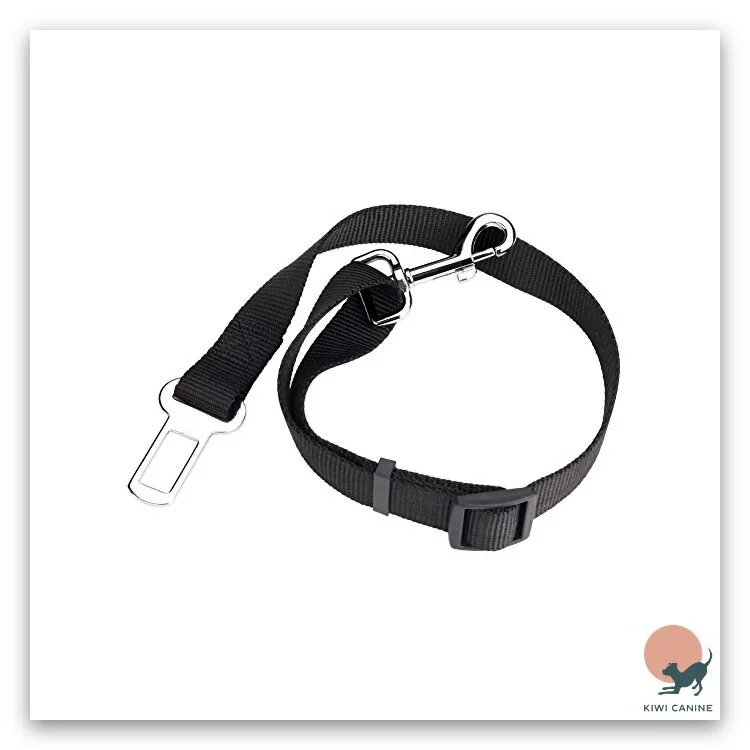
To receive FREE shipping CHCH-wide from our Specialist Online Store on all orders over $50, use this exclusive Sit Happens Client discount code that also unlocks some other perks (like 20% off Seatbelt Attachments): SITHAPPENS50
Puppy Fun and Focus - Week 3
What have we done in class? Again, some very important exercises. Getting the pups used to being handled is a must in order to prevent drama at the vets, around nail trimming and grooming. You will regret not having done it while your pup was still young, so please don't let it get to that.
It is important you start your leash walking training early as anytime your pup pulls on the lead it will get harder to train them not to.
And of course the Touch cue was so easy already. It’ll become your best trick! It helps them refocus on you, you can use it to move them to a certain point, like on the scale or out of the way and pups usually find the cue itself quite fun which means it makes for an awesome Recall.
Please make use of practising focus in playtime at the end of class. Getting a dog that is happy to respond to their guardians even when playing with their mates is not easy, but we have the perfect platform to work on this. Our pups need to understand there is no disadvantage in listening to you, even when there is cool stuff happening. Best choice is your Reflex to Name exercise.
Enjoy the videos and explanations of week 3.
Remember to bring 2 of the same toys next week to learn 'Drop'
〰️
Remember to bring 2 of the same toys next week to learn 'Drop' 〰️
Reflex to name
Remember what was shown in the seminar in regards to making the response to the pup's name a reflex? We need about 2500 repetitions of the classical conditioned name calling for it to start working. So, please repeat this all the time.
What to do? Have a bunch of treats on you and randomly throughout the day (whatever the pup is doing, standing, laying, sniffing, sleeping, sitting) say their name in a recognisably fun way and within 2 seconds after deliver a treat to their mouth. VERY IMPORTANT EXERCISE!
First Name - Treat After! Max 5 at a time.
Reflex to Name vs. Recall:
Technically a RTN just requires a turning of the head, so when doing more advanced training, you may shout the name to the dog on a far distance and they look at you (without moving towards you) and you ask them a cue like 'Down' or 'Sit' (which would be performed on the distance) or 'Come' or 'Touch' (which would return the dog to you), so there is no need for the dog to come running to you on the RTN. We do however want to work towards close to a 100% response to this, so whatever it is they are doing, when they hear the reflex word, they stop and look at you. Remember, some families choose a different word as they can't guarantee to be consistent with not using the name in a non-training context.
A lot of people train the reflex word as part of their recall cue though and that is perfectly fine as well, we would however always suggest to still use a recall cue rather than just the name. So, you'd shout "Fluuuffyyy, Touch" and Fluffy may already be on their way to you after you shouted their name, but the 'touch' or 'come' or whatever word you use gives them a clear indication of what exactly you are after.
Popping a behaviour on Cue
A cue you're teaching such as a verbal "down” should always come before a prompt, such as an already-learned hand signal. This is because we want the cue to be the tip-off for the prompt so that the prompt can eventually be faded. And to serve as a tip-off, it must come first and separate.
We have used a lure in class for the Sit, Down and Stand. Now, obviously we don't want to have a dog that will only perform those behaviours if we have a treat at their nose. So, we quickly need to get rid of the lure and introduce the cue. As soon as your pup performs the behaviour reliably, you start using the same hand movements as before, but there is no treat in the hand. You then mark the right behaviour with your ‘YES’ and bring a treat out to reward afterwards. Your pup will learn there doesn't need to be a lure at its nose because the reward comes anyways. Once this behaviour is reliable you add the cue, so the word 'Sit' or 'Down' or 'Stand' in this case. You say the cue before the routine of making the hand movement and then ‘YES’ and reward. You repeat this until you see that your puppy starts going into the desired position without thinking about it. You can now start raising your body in order to eventually stand up completely straight. Keep the routine up of saying the cue and showing the hand movement. We want the pup to know both as a cue, the verbal and the body language.
LOOSE LEASH WALKING
If you can't get your dog to follow you around your house or your backyard, you're not ready to take them for a walk in the real world, which is filled with unpredictable, uncontrollable distractions and stimuli.
Once you can get your dog to walk through your home on a loose-leash, you're ready to go out the front door. As soon as you do, you'll want to stop, wait, and watch.
Give your dog time to take in the environment. Can you still get your dog's attention? Will your dog still offer Default Eye Contact attentively? If not, don't go any further out into the world. Stay put until your dog has acclimated enough that they will be able to focus again.
Train Your Dog To Walk Calmly
FIRST TRAIN AT HOME!
1. Default Eye Contact Off Leash
2. Default Eye Contact On Leash
3. Walk Off-Leash
4. Walk On-Leash
LEAVE HOME SLOWLY
1. Don't Walk - Wait and Watch
2. Walk Back and Forth
The number 1 rule with lead walking is DO NOT REWARD THE PULLING. If your puppy gets to where they want to go by pulling you are strongly reinforcing this behaviour. That's a frustrating thought, I know, because you sometimes have to get places, but lead walking isn't sorted yet, so what should you do? I personally put a lot of effort into getting my pup keen on her toy the second I got her. That meant for me that if I quickly had to get somewhere I could just play with her on my side and she wasn't pulling while I didn't do lead training. This won't work everywhere, always and with all puppies though. So, you need to find what works for you. While you spend multiple sessions a day doing lead training you should still be able to go to the park. There are different options to do this. If your puppy is happy being carried and the park is close you could do this and then just pop them on a harness and a long line. Alternatively you can have them in a buggy or drive them with your car to the park. The same counts for coming into the training location, don't let them pull. You have learned a valuable approach to lead walking in our last session. As long as you put the time into doing the training, you will see great progress. Remember you start with 1 step and then go to 2 and then to 3 and so on in your living room. Once you have reached 10 steps with your pup on a lose lead and stopping as soon as you stop to look at you, you can now go to a harder environment, like your backyard. Start at 1 step again and work your way up to 10. Then front yard, driveway and so on. Make it a game to get to more steps and soon you can make it to the park. :)
Walks with your dog are much more enjoyable when your dog is beside you on a loose leash instead of pulling ahead of you! Loose leash walking is a skill that takes patience, consistency and practice. It’s much easier if you start this from puppyhood.
Equipment - The best equipment to use is a good fitting harness. Check the leash and harness clips to ensure they won’t break. A harness does not encourage the dog to pull unless they already have a prior association of pulling with it and if they do have an association with it, find a different harness to create a new no-pulling association. While loose-leash-walking-training is in progress, drive to the park and use a long line (10 metres) to give your dog sniffing opportunities without pulling on the lead. Watch here how a nice mooch-walk could look like, note: the dog is leading the walk, but can be invited to change direction if necessary. It's a really nice video that hopefully makes you consider a different approach to your outings that are there for your dog. A 20 minute walk where your dog actively uses its nose is as valuable as a 40 minute run and much more appropriate for a puppy.
Follow Me! The principles of loose leash walking are essentially teaching your dog to follow you, not the other way around, and praising your dog for being beside you and focussed on you. They get rewarded for stopping when you stop. Beside you is the best place for your dog to be because that’s where they love to hang out and all the good stuff happens. When dogs pull on the lead they are rewarded by getting where they want to go and we get pulled along behind them. Instead, you want to reprogram your dog’s thought process so that they think having a loose leash is what enables them to move forward.
Happy loose leash walking!
These are some random puppies from class showing their lead walking training in week 6. They walk with their mums and dads on a loose lead and when the owners stop, the pup stops and looks at them. Please note, that technically the pups could be sniffing around while walking. There is no need for them to look up whole time, only when the walker stops.
Looking forward to seeing you in week 4! :)