(private information for SCDR AND CBBR)
Don't punish the growl
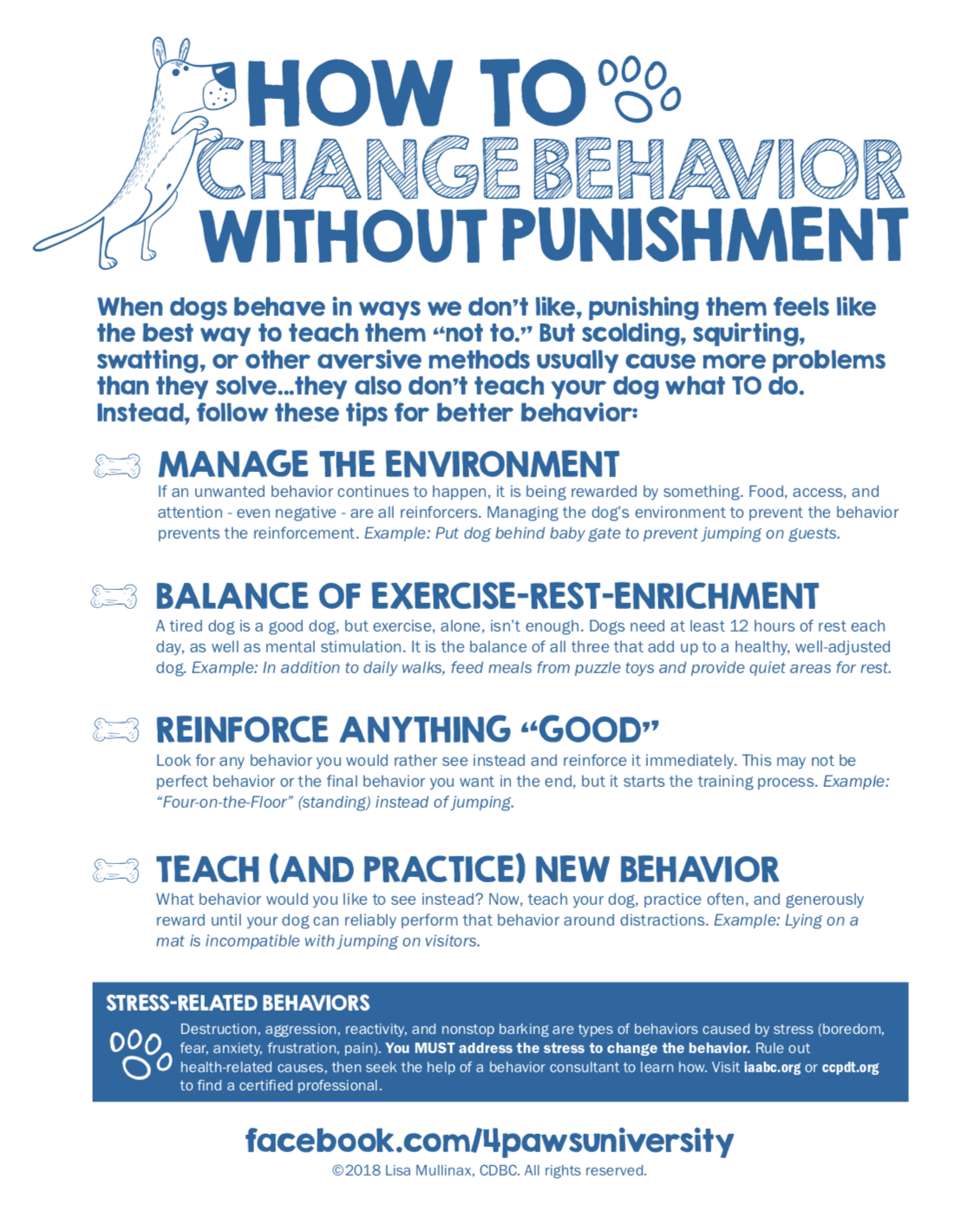
Punishment can suppress aggressive and fearful behavior when used effectively, but it may not change the underlying cause of the behaviour. For instance, if the dog behaves aggressively due to fear, then the use of force to stop the fearful reactions will make the dog more fearful while at the same time suppressing or masking the outward signs of fear; (e.g., a threat display/growling). As a result, if the dog faces a situation where it is extremely fearful, it may suddenly act with heightened aggression and with fewer warning signs. In other words, it may now attack more aggressively or with no warning, making it much more dangerous.
'Dominance' and Punishment
Dominance is defined as a relationship between individual animals that is established by force/aggression and submission, to determine who has priority access to multiple resources such as food, preferred resting spots, and mates. In our relationship with our dogs, priority access to resources is not the major concern. The majority of behaviours owners want to modify are not related to valued resources and usually don't involve aggression. Rather, these behaviours occur because they have been inadvertently rewarded and because alternate appropriate behaviours have not been trained instead. Therefore, owners want to obtain the ability to influence their dogs to perform behaviours willingly which is considered leadership, not dominance. Consequently, we must find a way to avoid reinforcing undesirable behaviours and only reinforce the desirable behaviours frequently enough and consistently enough for the good behaviours to become a habit. (If you would like to read more about dominance, you can find more detailed info here).
Punishment or the use of aversives can have serious adverse effects that can be difficult to reverse. Even when punishment seems mild, in order to be effective, it often must elicit a strong fear response, and this fear response can generalise to things that sound or look similar to the punishment. Some punishments may not cause physical harm and may not seem severe, but they can cause the animal to become fearful, and this fear may generalize to other contexts.
Perhaps one of the most compelling reasons to use punishment sparingly is that punishment fails to address the fact that the bad behaviour is occurring because it has somehow been reinforced, either intentionally or unintentionally. That is, owners tend to punish bad behaviours some of the time while inadvertently rewarding these same behaviors at other times. In this way, they accidentally set their pets up to receive punishment repeatedly by sometimes unintentionally rewarding the bad behaviour, which is how the behavior was learned in the first place. This inconsistency is confusing to the animal and can cause frustration or anxiety. Punishment also fails to tell the animal what it should be performing instead. Without an alternative appropriate behaviour the animal may have no option but to perform the undesired behaviour. (If you would like to read more about punishment, you can find more detailed info here).
At Sit Happens we work with the LIMA principle (Least intrusive - minimally aversive) for named above reasons and for ethical reasons.